
Tennis elbow can make surprisingly ordinary tasks feel demanding. Turning a key, pouring from a kettle, carrying groceries or using a mouse may produce a sharp ache at the outside of the elbow. The name suggests racquet sport, but many people who develop the condition have never held a tennis racquet.
Clinicians often call the presentation lateral elbow tendinopathy. The wrist-extensor tendons attach near the bony outside of the elbow and help stabilize the wrist during gripping. Repeated or unfamiliar load can exceed their current capacity. The result is usually a loading problem, not a tendon that has torn away because one coffee mug hurt.
For people dealing with tennis elbow and forearm pain in Markham, recovery is often gradual. The best plan identifies the actual sources of load, preserves useful activity and rebuilds grip and wrist strength. Complete rest may calm symptoms temporarily, but it does not prepare the arm for the task that needs to return.
Recognize the usual symptom pattern
Lateral elbow tendinopathy commonly causes pain near the outside bony point of the elbow. Symptoms may extend a short distance down the upper forearm. Gripping, lifting with the palm down, resisted wrist extension or repeated tool use can provoke it.
The pain may begin after a concentrated project—painting, pruning, assembling furniture—or after a change in sport, gym volume or computer workload. Sometimes the increase is subtle: more mouse use at work combined with weekend home repairs.
Morning stiffness can occur, and the first few lifts may feel worse before the arm warms up. A broad ache that changes with load fits better than constant neurological symptoms, but an assessment is needed to distinguish overlapping conditions.
Not every outer-elbow pain is tennis elbow
The elbow joint, radial nerve, neck and other tendons can refer pain to the same area. Numbness or tingling into the hand, marked neck-related change or weakness not explained by pain may point away from a straightforward tendon presentation.
A fall, forceful pull or sudden pop with bruising requires assessment for a more significant injury. A visibly deformed elbow, inability to move after trauma or a cold, discoloured hand needs urgent care. Redness, heat, major swelling and fever can indicate infection or inflammatory disease.
Persistent night pain unrelated to position, unexplained weight loss or a rapidly growing lump also warrants medical review. These signs are uncommon, but they should not be managed with generic forearm exercises.
A useful assessment looks beyond the tender point
The clinician should ask about onset, work, hobbies, sport, neck symptoms and previous injury. They may test grip strength with the elbow in different positions, resisted wrist movement and tenderness around the attachment. Comparing sides can provide context, though the dominant arm is often naturally stronger.
The neck, shoulder and nervous system may be screened. A task demonstration is valuable: the way someone holds a drill or racquet can reveal a workload issue that an isolated test misses.
The 2022 clinical practice guideline for lateral elbow pain recommends outcome measures and impairment-based examination. A good assessment ends with measurable goals, such as carrying a grocery bag, typing through a work block or completing a controlled backhand.
Imaging is rarely the first requirement
Many cases can be identified from history and examination. Ultrasound or MRI may show tendon changes, but those findings do not automatically predict pain or determine recovery.
Imaging may be considered after trauma, when another diagnosis is suspected or when symptoms fail to respond to an appropriate program. X-rays may help evaluate the joint or bone in selected cases.
Ask what clinical question the image will answer. Starting a safe strength and workload plan often provides more useful information than waiting for a scan that may not change management.
Find the combined gripping load
Count more than exercise. Mouse work, carrying a laptop, cooking, opening jars, holding a phone, home projects and racquet sports all contribute. Even gripping a steering wheel tightly during a long commute adds sustained effort.
Identify the tasks that combine strong grip with wrist extension or rotation. These are often the most provocative. The aim is to reduce the peak or repetition temporarily, not eliminate hand use.
Use two hands for a heavy kettle, choose smaller grocery bags and alternate tools where practical. Break a long project into shorter blocks. These changes preserve activity while creating room for the tendon to adapt.
Use pain response to select the dose
Tendon rehabilitation does not always need to be completely pain-free. Mild discomfort during an exercise may be acceptable when it remains stable, movement is controlled and symptoms settle afterward. A substantial increase lasting into the next day suggests that the load, repetitions or range were too high.
Establish a response rule with the treating professional. Record the exercise dose and one functional task rather than testing every object in the house. Consistency makes the pattern easier to interpret.
Pain intensity alone is not the whole outcome. Improving grip, work duration and confidence can occur while some local tenderness remains.
Begin with isometric wrist work when appropriate
An isometric exercise contracts muscle without visible joint movement. The forearm can rest on a table while the opposite hand or a band provides resistance against wrist extension. This may be a tolerable entry point for an irritable elbow.
The contraction should feel purposeful but controlled. Keep the fingers and shoulder from gripping unnecessarily. A clinician can adjust wrist angle, elbow position, duration and effort.
Isometrics are not uniquely curative. They are one way to introduce load. As tolerance improves, the program should move toward exercises that shorten and lengthen the muscles through a functional range.
Progress wrist-extensor strength
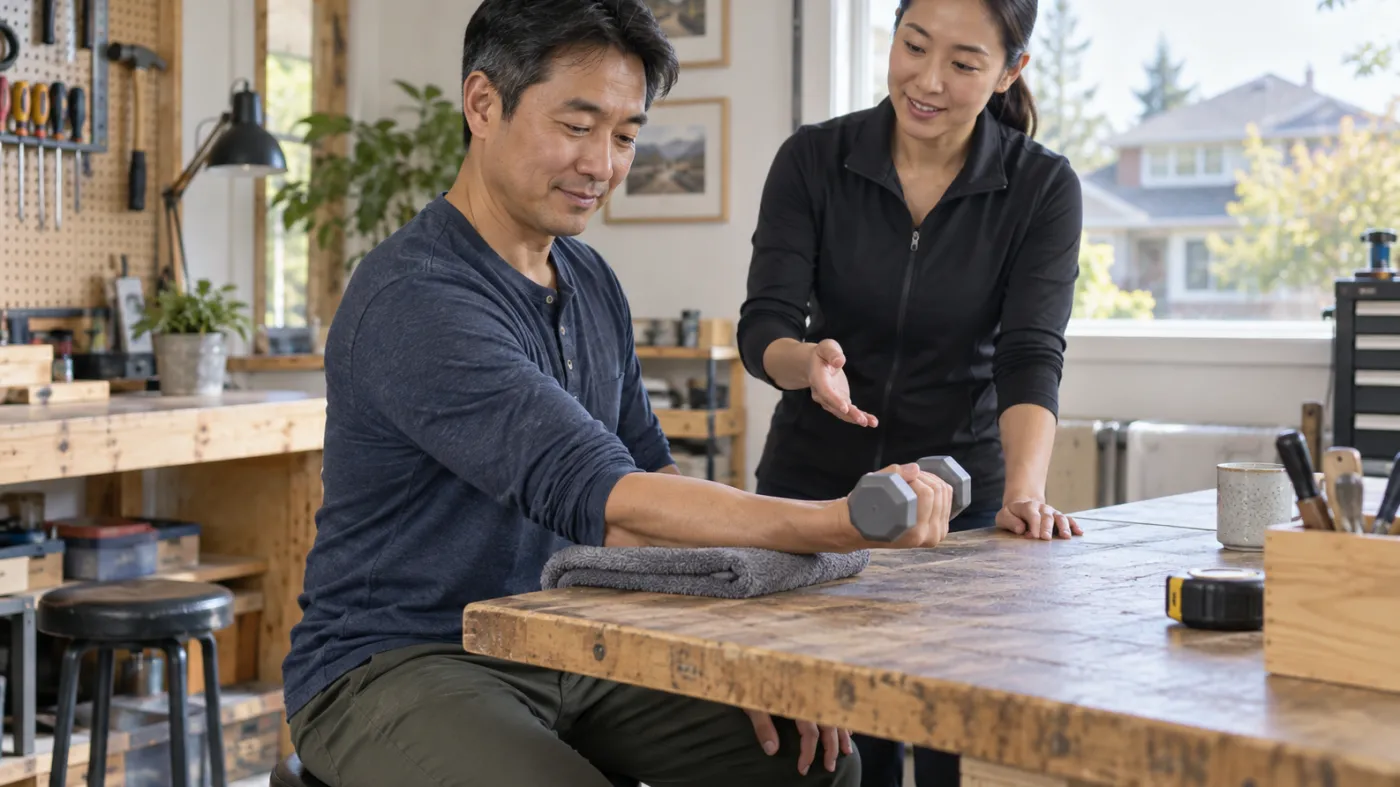
With the forearm supported and palm down, lift a light weight by extending the wrist, then lower slowly. Start with a load that permits smooth repetitions. If lifting is too painful, use the other hand to assist the upward phase and control only the lowering phase.
Over time, increase resistance or repetitions, not both at once. Add forearm rotation, wrist flexion and grip work so the arm is prepared in several directions. Daily tasks rarely isolate one tendon.
The guideline supports resisted exercise for wrist extensors in subacute and chronic lateral elbow pain. The exercise choice should still be individualized; a generic three-set prescription is not automatically the right dose for a mechanic and a desk worker.
Train grip without squeezing everything maximally
Begin with a soft ball, folded towel or grip device at a moderate effort. Hold briefly and release fully. Progress toward heavier objects and task-specific handles.
Grip strength is influenced by wrist position. Holding the wrist near neutral may initially feel easier than letting it collapse forward while lifting. This is a load-management option, not a rule that the wrist must remain straight forever.
Eventually practise the real demand. A gardener may hold pruners, a tradesperson may control a drill and a tennis player may progress from shadow swings to ball contact. Capacity needs to transfer beyond the therapy table.
Include shoulder and whole-arm capacity
The forearm does not work alone. Rows, external rotation, presses and carries can build the shoulder and trunk support needed for repeated hand use. This does not imply that a weak shoulder caused every elbow symptom.
For a lifting task, practise using the legs and both arms where appropriate. For racquet sport, footwork and trunk rotation can distribute force. The aim is efficient variety rather than one perfect technique.
General strength also makes it easier to reduce reliance on the painful side during a flare without permanently avoiding it.
Adjust the workstation thoughtfully
Move the mouse close enough that the shoulder can relax and the forearm is supported. A mouse that fits the hand may reduce unnecessary gripping. Keyboard shortcuts can temporarily reduce repeated mouse clicks.
Do not plant the outer elbow on a hard edge for hours. Use a smooth support surface and vary position. Short breaks can include opening and closing the hand gently, moving the wrist and walking away from the desk.
Ergonomic equipment helps only when it matches the person and task. A vertical mouse is not automatically a cure and may introduce a new loading pattern if adopted abruptly. Trial one change at a time.
Modify tools and household tasks
A larger handle can reduce the amount of grip force required. Keep cutting tools sharp so the hand does not compensate for a dull blade. Use a power tool for high-volume work when safe and appropriate.
Position the work close enough that the elbow is not held at full reach. Rotate between tasks instead of repeating the same wrist action for an entire afternoon. Wear work gloves that fit; oversized gloves can increase grip demand.
During cooking, slide a heavy pot before lifting, use two hands and pour smaller amounts. These are temporary workload strategies, not signs that the arm is permanently fragile.
Braces and taping are optional supports
A counterforce strap around the upper forearm may reduce pain during selected tasks for some people. A wrist brace can limit provocative extension temporarily. Fit matters: a device that causes numbness, swelling or more pain should be removed.
Braces are not intended to replace strength or be worn automatically forever. Use them for a defined purpose, such as a work block, and reassess whether function actually improves.
Taping may offer short-term symptom relief. As with bracing, it creates a possible window for activity; it does not repair or realign the tendon.
Be careful with passive quick fixes
Manual therapy may provide short-term relief and can be used alongside exercise. It should not be presented as breaking scar tissue or putting the elbow back into place. The key long-term work is restoring load tolerance.
Medication or injection decisions belong with a physician or pharmacist who understands health history. Corticosteroid injections may produce short-term relief but can have less favourable longer-term considerations in tendon care. The expected benefit and alternatives should be discussed clearly.
Other options such as shockwave therapy or surgery are considered in selected persistent cases after the diagnosis and rehabilitation plan have been reviewed. Most people do not begin there.
Return to tennis or racquet sport in stages
Start with footwork and controlled shadow swings, then short-court hitting at an easy pace. Progress the number of strokes before full speed or competitive play. Backhands and serves may need separate progression because they load the arm differently.
Racquet grip size, string setup and technique may influence comfort, but equipment is not the only factor. A coach can help identify late contact or excessive grip pressure. Change one variable at a time so the response is clear.
Warm up the entire body and complete a few light wrist exercises before play. Avoid using the first match as the warm-up. Plan recovery before scheduling several consecutive days.
Return to work with measurable steps
List the specific demands: tool weight, grip time, repetition and awkward positions. A temporary modification may reduce continuous tool use, alternate hands or introduce microbreaks. The plan should also include graded exposure so full duties do not arrive as a sudden jump.
Measure what improves. That may be minutes of mouse use, kilograms carried or number of fasteners installed before symptoms escalate. A vague instruction to “take it easy” is difficult for both worker and employer to apply.
If work repeatedly produces a large next-day flare, the dose or recovery time needs revision. This is not proof that all work is harmful.
A practical next step in Markham
For one week, note the tasks that require sustained grip and the ones that combine grip with wrist movement. Choose one meaningful function to track. Bring that record to an assessment and ask how each exercise prepares you for that demand.
Tennis elbow usually responds to patience more than protection. Reduce the sharpest workload spike, introduce tolerable resistance and rebuild the actual task in stages. The goal is not merely a less tender elbow—it is a hand and forearm ready to work, play and carry everyday life again.