
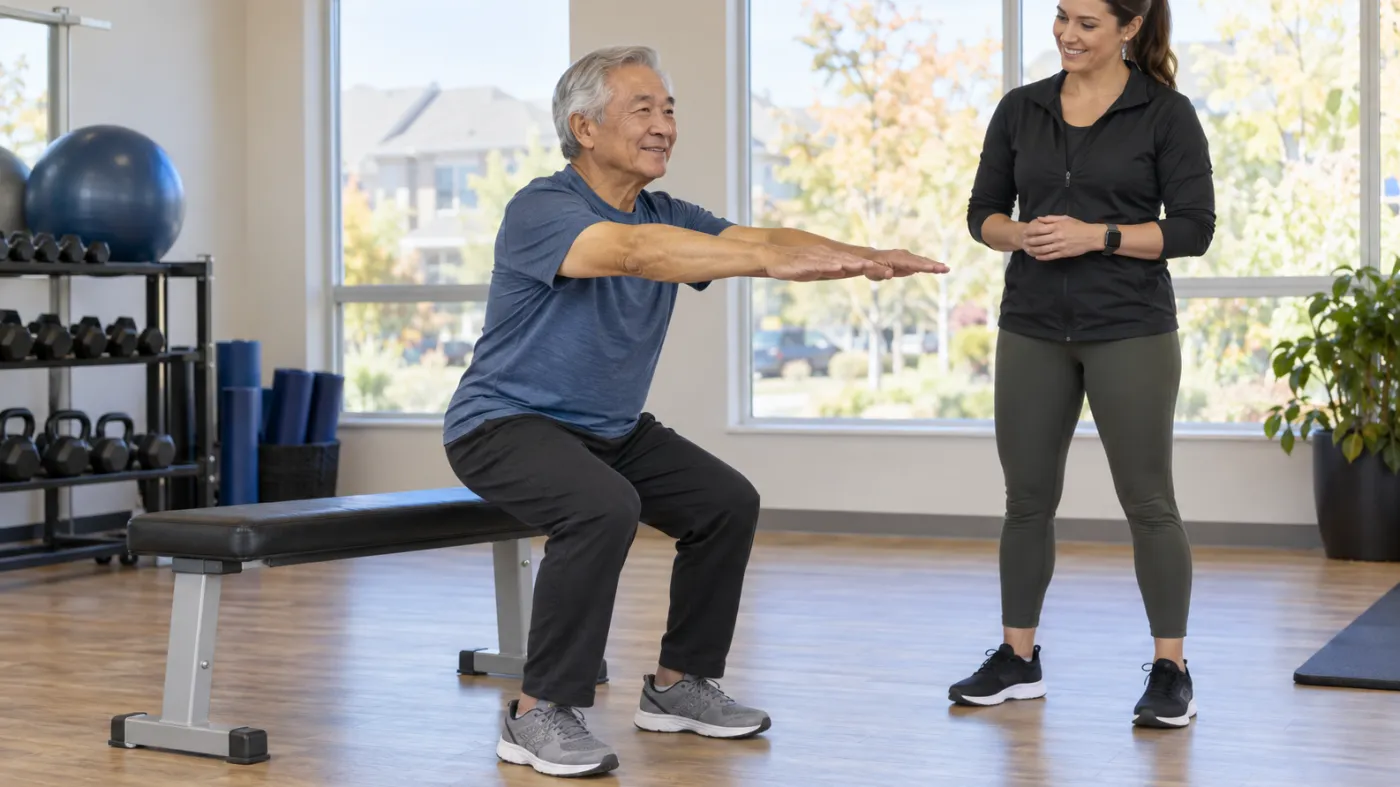
Strength training becomes more relevant with age, not less. The ability to rise from a chair, climb stairs, carry groceries, recover balance and participate in favourite activities depends partly on muscular strength and power. Those qualities can improve when training begins at an appropriate level and progresses consistently.
Starting does not require a background in gyms. Resistance can come from body weight, bands, machines, dumbbells or household tasks. The best tool is one that can be controlled, adjusted and used often enough to create adaptation.
Older adults in Markham can choose municipal fitness centres, community classes, private facilities or home programs. Setting matters less than fit: the program should reflect current health, confidence, access and goals. Age alone does not determine what someone can do.
Begin with the life you want to support
“Getting stronger” is broad. Identify the task that matters. It may be getting off the floor, carrying a grandchild, walking hills, tending a garden or returning to travel. The goal shapes the exercises and helps measure progress.
If stairs are difficult, leg strength and balance are relevant. If grocery bags are the issue, pulling, grip and carrying deserve attention. A recreational golfer may need a different emphasis from someone preparing for joint replacement.
Write down two functional goals and one routine goal, such as attending twice weekly. Function keeps the program meaningful; routine makes it happen.
Check readiness without assuming fragility
Most older adults can participate in some form of resistance training, including many people living with chronic conditions. The starting point and monitoring may need adjustment. Review new or unstable symptoms, medication effects, recent surgery and exercise restrictions with the appropriate healthcare professional.
Use a pre-exercise screening process if offered. Bring a medication list and disclose falls, dizziness, chest symptoms, uncontrolled blood pressure or significant joint problems. A qualified professional can help interpret these factors without excluding activity unnecessarily.
Urgent symptoms require medical care, not a modified workout. Stable conditions often benefit from movement when the plan is individualized.
Learn five useful movement families
A full program does not need twenty exercises. Begin with patterns that relate to daily life:
- Sit and rise: chair stands, squats or leg press.
- Step: low step-ups or split-stance movements.
- Pull: resistance-band rows or machines.
- Push: wall push-ups, machine or dumbbell presses.
- Carry and stabilize: holding weights, suitcase carries or controlled trunk work.
Hip hinges, calf raises and overhead work may be added according to goals and ability. Each pattern has easier and harder versions. A chair stand can begin with arm support, progress to no hands and later add external resistance.
Choose a starting dose that invites the next session
During the first week, use a resistance that feels light to moderate and allows smooth, repeatable movement. One set of six to ten repetitions may be enough to learn an exercise. Stop before form or breathing becomes uncontrolled.
Leave at least a day between challenging sessions for the same muscle groups when beginning. Mild muscle soreness can occur after unfamiliar exercise, but severe soreness that limits daily life suggests too much volume.
The Canadian 24-Hour Movement Guidelines recommend muscle-strengthening activities using major muscle groups at least twice weekly for adults 65 and older. This is a destination that can be approached gradually, not a requirement to perform a large program immediately.
Progress by changing one variable
When an exercise feels controlled across several sessions and recovery is normal, add a small challenge. That could mean another repetition, slightly more resistance, less hand support or one additional set. Avoid changing all of them together.
Use an effort scale. A working set might feel moderately challenging while still leaving two or three good repetitions in reserve. Not every set needs to approach the maximum.
Keep a written record. Memory can underestimate progress because improvements happen gradually. A log also helps a clinician or trainer understand fatigue or symptoms.
Train power after establishing control
Everyday balance recovery sometimes requires producing force quickly. Power training uses a controlled but intentional faster movement, such as rising from a chair promptly and lowering slowly. It may help functional ability when introduced appropriately.
Speed work is not the first step for everyone. Establish the movement and make sure the environment is safe. A qualified professional can decide whether faster sit-to-stands, light medicine-ball actions or other power exercises are suitable.
Fast does not mean rushed. The movement should remain coordinated, with enough rest between efforts.
Include balance as a specific skill
Walking is valuable, but it may not provide enough balance challenge for every person. The guidelines advise older adults to include activities that challenge balance. This can involve narrower stances, stepping in different directions, controlled turns or standing on one leg with support nearby.
Balance exercise should be challenging enough to require attention but safe enough that a loss can be recovered. Practise near a stable counter or railing, not a movable chair. Have supervision if fall risk is significant.
Progress by using less hand support, changing the base or adding movement—not by closing the eyes on an unsafe surface without guidance.
Use machines, bands and free weights according to purpose
Machines provide a stable path and easy load changes. They can be useful for beginners or for isolating a muscle group. They must still be adjusted to the person; a seat or pivot in the wrong place can be uncomfortable.
Bands are portable and inexpensive, though tension changes through the range and worn bands can snap. Inspect them and anchor them securely. Free weights train control in open space and make carries easy to load, but require safe handling and storage.
No equipment category is inherently superior. A mixed program may be practical. Choose based on access, confidence and the movement being trained.
Breathe through the effort
Holding the breath during a difficult repetition can produce large blood-pressure changes. Exhale through the effort and inhale during the easier phase, while keeping enough trunk tension to control the movement. Do not hyperventilate.
People with cardiovascular conditions, pelvic-floor symptoms or specific medical concerns may need tailored breathing and load advice. Stop for chest pressure, unusual shortness of breath, faintness or palpitations and seek appropriate care.
Rest long enough between sets for breathing and balance to recover. Strength training does not need to feel like a race.
Adapt for arthritis and joint sensitivity
Osteoarthritis does not automatically prohibit resistance exercise. Adjust the range, load, equipment and time of day. A supported squat to a higher chair may be better tolerated than a deep squat, while a neutral-grip press may feel better for a sensitive shoulder.
Some discomfort can be acceptable if it stays mild, movement remains controlled and symptoms return to baseline as expected. Sharp pain, increasing swelling, joint giving-way or a worsening next-day response signals a need to modify and possibly seek assessment.
During a flare, reduce load or train another region rather than assuming the whole program must stop.
Protect bones with appropriate loading
Resistance and weight-bearing activity can support bone health, but osteoporosis changes exercise planning. People with known low bone density, vertebral fracture history or high fracture risk should receive individualized guidance.
The goal is not to avoid all spinal movement. It is to manage load and technique according to fracture risk, particularly with heavy flexion, twisting or impact. Learn safe ways to lift, get to the floor and progress resistance.
Medication, nutrition and fall prevention may also be part of bone-health care. Exercise works within that broader plan.
Practise getting down and up when appropriate
Floor transfers matter for gardening, playing with grandchildren and recovering after a non-injurious fall. They can be trained as a sequence: lower to a sturdy support, move to half-kneeling, bring a knee down and reverse the steps.
This requires enough knee tolerance, balance and upper-body support. Begin with supervision if uncertain. Do not practise on the floor alone when you are not confident you can get up.
Learning the skill can reduce fear and expand activity options, but it should not replace emergency planning for someone at high fall risk.
Combine strength with walking and aerobic activity
Strength sessions complement, rather than replace, walking, cycling, swimming or other aerobic activity. Canadian guidance recommends accumulating at least 150 minutes of moderate-to-vigorous aerobic activity weekly, along with several hours of light activity and reduced prolonged sitting.
Some people will start below these amounts. Any movement toward the guideline can provide benefit. Distribute activity across the week so a demanding leg session does not make every walk unpleasant.
Recovery includes sleep and enough food. Unintentional weight loss, poor appetite or difficulty obtaining protein-rich foods should be discussed with a healthcare professional or registered dietitian.
Choose instruction carefully
Look for a professional with recognized training and experience with older adults and relevant conditions. They should ask about goals and health history, explain exercises clearly and offer progressions rather than treating age as a diagnosis.
Group classes can add structure and connection, but the instructor must be able to provide alternatives. Visit the space, ask about accessibility and ensure music or group size does not prevent hearing instructions.
Beware of anyone who guarantees that one exercise corrects every posture, discourages medical care or pushes through symptoms to prove commitment.
Know when to stop and seek care
Call emergency services for chest pressure, severe shortness of breath, fainting, sudden facial droop, speech difficulty or new one-sided weakness. Stop after a fall with suspected fracture, head injury or inability to bear weight.
Arrange assessment for progressive weakness, repeated dizziness, unexplained decline in exercise tolerance, a hot swollen joint, persistent pain or balance changes. Review medication effects if light-headedness occurs when standing.
After illness or hospitalization, return at a lower level. The first sessions are reassessment, not proof that no fitness was lost.
Strength is a long-term practice
Progress may appear as a heavier weight, but it can also be an easier stair climb, steadier step, lower chair or more confident grocery carry. Those changes matter.
Strength training for older adults in Markham should be challenging, adaptable and connected to life. Begin with a small repeatable program, include balance, recover between sessions and add one demand at a time. The goal is not to train as if age does not exist. It is to train in a way that respects experience while continuing to build capacity.
This article provides general education and is not a medical clearance or individualized exercise program. Seek urgent care for severe cardiac, neurological or traumatic symptoms.