
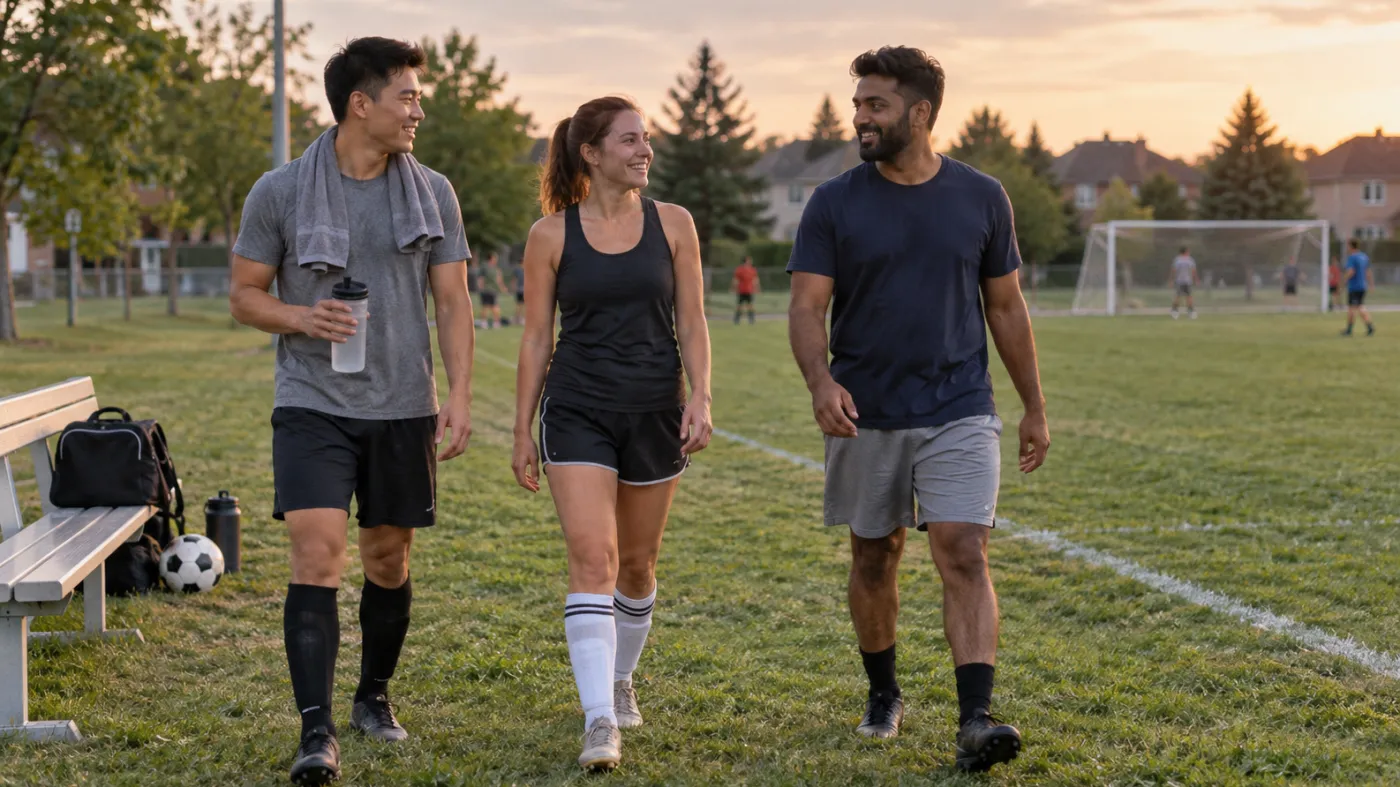
Recreational soccer compresses a lot of physical demand into a short evening. A player may sit at work all day, drive to the field, warm up quickly and then sprint, cut, kick and compete for an hour. The match ends late, the commute home begins and sleep may come only after the body has been highly activated.
Recovery is not a product or a punishment workout the next day. It is the process of restoring enough energy, movement and confidence to handle the next demand. For a weekly Markham league, that demand may be the following match. For someone playing twice a week and coaching a child’s team on the weekend, the total schedule is more complex.
The best recovery plan starts before kickoff with preparation and continues through sleep, food, activity and appropriate response to symptoms. It should make soccer easier to sustain, not turn leisure sport into a second full-time job.
Count all of the week’s soccer
A formal match is not the only exposure. Warm-ups, practices, pickup games, coaching demonstrations and individual fitness sessions add running, kicking and direction changes. So do other sports.
Write the week on one page. Mark high-intensity days, lower-intensity activity and true rest. Two matches on consecutive nights create a different recovery need from one Sunday game. Sudden tournament weekends deserve preparation in the weeks before them.
If the schedule cannot change, reduce optional high-intensity work. Another sprint session is rarely the answer between two demanding matches.
Use a structured warm-up consistently
Recovery and prevention overlap. A well-designed warm-up prepares players for the match and can reduce certain injuries when used regularly. Programs such as FIFA 11+ combine running, strength, balance, agility and controlled landing or cutting activities.
The value comes from consistency and correct execution, not performing the routine once before playoffs. Teams can learn the program from qualified sources, assign someone to lead it and begin early enough that kickoff does not shorten it.
Progress from easy movement to faster soccer actions. Include the ball once the body is ready, and save maximal sprints for the later phase. A few casual toe touches beside the bench are not a complete warm-up for sprinting and cutting.
Cool down by changing the demand gradually
After the final whistle, walk for several minutes while breathing settles. This creates a transition from competition to recovery and offers a chance to notice symptoms that adrenaline may have masked.
Static stretching is optional. It may feel relaxing, but it does not remove lactic acid, guarantee less soreness or repair an injury. Use comfortable stretches without forcing range. A hard post-match conditioning circuit is not a cooldown.
If the match ends late, keep the routine short and repeatable: walk, change damp clothing, hydrate, eat and begin the trip home safely.
Rehydrate according to conditions
Fluid needs depend on heat, humidity, match duration, clothing and individual sweat rate. Drink before arriving thirsty and use breaks permitted by the league. In hot conditions, organizers should follow heat policies and provide access to water.
After the match, replace fluid gradually. Urine colour can offer rough context but is not a precise diagnostic tool. Excessive water without electrolytes can be dangerous, so more is not always better.
Sports drinks may be useful during prolonged, hot or repeated activity. Water and ordinary food are sufficient for many routine matches. People with medical conditions affecting fluid or sodium should follow individualized advice.
Eat for recovery without overcomplicating it
A post-match meal or snack containing carbohydrate and protein supports replenishment and tissue repair. Practical late-evening options might include yogurt and fruit, a sandwich, rice with eggs or leftovers prepared in advance.
The exact timing is less important than meeting overall energy and nutrient needs, particularly for recreational players with one weekly match. Avoid restrictive eating that leaves training consistently under-fuelled.
Alcohol can impair sleep, hydration and decision-making. If it is part of the social event, consider amount, food, transportation and the next day’s demands. No recovery supplement can cancel heavy alcohol use.
Protect the first hours of sleep
Late soccer can delay the normal wind-down. Bright field lights, intense play and team conversation keep the nervous system alert. After arriving home, use a simple routine: light meal, shower, dimmer light and reduced work or scrolling.
Do not sacrifice sleep for elaborate recovery. Compression devices and long stretching routines have limited value if they keep you awake. A cool, dark room and consistent wake time may do more.
If the match schedule repeatedly leaves too little sleep before work, consider a different league time or reduce other late-week demands. Recovery is constrained by the calendar.
Expect some soreness, but read the pattern
Delayed muscle soreness often appears one or two days after unfamiliar sprinting, kicking or tournament volume. It tends to be diffuse, symmetrical and better with gentle movement. Focused joint pain, marked swelling, bruising, weakness or an altered walk is different.
Use the next morning as information. Can you walk stairs normally? Does the knee feel stable? Is calf soreness equal on both sides? A short easy walk may help ordinary stiffness. Repeatedly testing a painful sprint or kick is unnecessary.
If soreness disrupts daily function, reduce the next match or training dose. Severe muscle pain, profound weakness and dark urine after intense activity require urgent medical assessment.
Use active recovery appropriately
An easy walk, gentle cycle or mobility session can promote movement without adding substantial load. Keep it easy enough that breathing and legs feel better afterward. Active recovery is not secret extra conditioning.
A complete rest day may be more appropriate after a demanding match, poor sleep or injury. Listen to overall fatigue, not only muscle soreness.
Foam rolling or massage may change how soreness feels temporarily. Use comfortable pressure and avoid injured, bruised or swollen areas. These tools do not replace progressive training or clinical assessment.
Strength train for the actions soccer demands
Soccer requires acceleration, deceleration, single-leg control, kicking and contact tolerance. General strength can create reserve. Squats, split squats, hinges, calf raises, rows, presses and trunk exercises are useful foundations.
Hamstring and adductor strengthening may be included with appropriate progressions. Faster running and change-of-direction drills should also be prepared rather than introduced only during games.
Schedule demanding leg strength away from the match when possible. A new high-volume workout two days before competition may create soreness without building useful match readiness in time.
Progress sprinting, not just jogging
Steady jogging does not prepare every soccer demand. After a fitness base is established, include progressive accelerations, higher-speed running and direction changes. Build speed and number of repetitions over time.
Warm up fully and allow recovery between fast efforts. Sprinting while highly fatigued changes the task and may not provide the intended quality.
Returning players often feel cardiovascularly fit before tissues are ready for repeated high-speed actions. A cycling or distance-running background helps endurance but does not replace soccer-specific exposure.
Manage cramps without myths
Exercise-associated cramping has several possible contributors, including fatigue and individual history. Hydration may matter, especially in heat, but not every cramp proves an electrolyte deficiency.
Stop, move out of play safely and gently lengthen the cramped muscle if tolerated. Do not immediately return to maximal sprinting because the sensation eased for one minute. Review conditioning, pacing, heat and fluid strategy.
Recurrent cramps, cramps with illness or medication concerns deserve professional review.
Treat minor knocks based on function
Contact can create bruises and temporary soreness. Check whether the player can bear weight, move the joint and use the limb normally. Protect a cut, control bleeding and follow league procedures.
Ice may reduce pain temporarily but is not mandatory for every injury. If used, protect the skin and limit exposure. Compression and elevation may help swelling in some cases, provided circulation is not impaired.
Do not use pain medication to return immediately without understanding the injury. A player who cannot run, cut or kick normally should leave the field.
Take concussion seriously
Concussion can follow a hit to the head, face, neck or body. Loss of consciousness is not required. Headache, dizziness, confusion, balance problems, nausea, vision changes or simply feeling “not right” are reasons to suspect it.
Remove the player from play and arrange appropriate medical assessment. They should not return the same day. Follow a graduated return to daily activity, work and sport under current Canadian concussion guidance.
Call emergency services for deteriorating consciousness, seizure, repeated vomiting, increasing confusion, severe or worsening headache, double vision, neck pain, weakness or tingling in the limbs.
Return after a muscle or joint injury
Calendar time is only part of readiness. A soccer return should rebuild walking, jogging, running, sprinting, cutting, kicking and contact as relevant. Confidence and next-day response matter.
Progress one feature at a time. A player may tolerate straight-line running before rapid direction change. Add training minutes before full match minutes, and consider a substitute role rather than immediate full-game participation.
Rehabilitation should be individualized to the injury, position and level of play. A generic stretch sheet is not enough for every hamstring, ankle or knee problem.
Know when to seek assessment
Urgent assessment is needed for suspected fracture or dislocation, inability to bear weight, a cold or pale foot, severe swelling, chest symptoms, significant head or neck injury, or rapidly progressive neurological signs.
Arrange timely care for persistent swelling, joint locking or giving-way, progressive weakness, focal bone pain, recurring muscle strains or symptoms that do not improve with sensible modification.
Redness, warmth and calf swelling without a clear minor injury can require urgent medical evaluation, particularly with breathing symptoms.
Build a recovery routine the team can follow
Team culture influences decisions. Encourage players to report symptoms, respect substitutions and avoid celebrating participation through significant injury. Keep water available, begin warm-up on time and plan the post-match meal before everyone is tired.
Recreational soccer recovery in Markham is not about optimizing every minute. Walk after the match, replace fluids and food, protect sleep, maintain strength and take head injuries seriously. A simple plan performed every week will do more than a complicated routine saved for the one match that leaves everyone sore.
This article is general education and not an injury diagnosis or individualized return-to-play plan. Suspected concussion and serious traumatic or neurological symptoms require prompt medical care.