
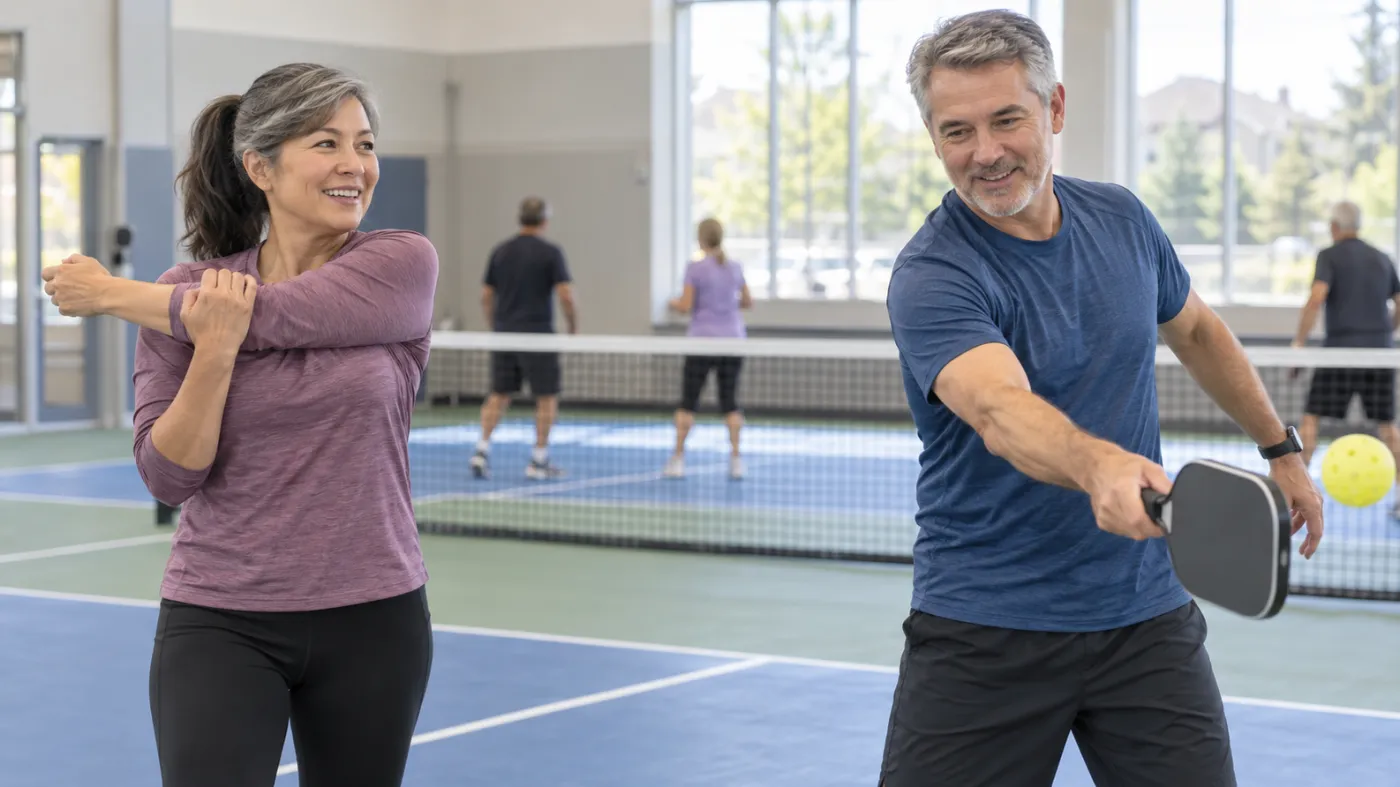
Pickleball is easy to start and surprisingly demanding to repeat. The court is smaller than a tennis court, but a session can include hundreds of grips, quick reaches, volleys and overhead shots. Social games often extend because another group needs a player or one more match sounds harmless. The shoulder and elbow may notice the accumulated volume before the rest of the body feels tired.
For recreational players in Markham, the schedule can also change quickly: occasional outdoor games become several indoor sessions each week, or a winter league is followed by a tournament. Comfort depends less on finding one perfect stretch and more on matching preparation, technique, equipment and recovery to the amount of play.
This guide focuses on common load-management decisions. It cannot diagnose pain, and it does not suggest that every ache comes from poor form. The aim is to help you notice patterns early and keep a manageable problem from becoming the only thing you think about on court.
Understand where the demand comes from
The shoulder positions the arm while the forearm, wrist and hand control the paddle. Repeated shots ask these regions to transfer force together. A late contact point, tight grip or frequent reaching can increase effort, but so can simply playing much more than usual.
The elbow is often discussed as if there is one “pickleball elbow.” In reality, symptoms can occur on the outer or inner side, around the joint, or from another source such as the neck. Tendons may become sensitive when repeated gripping and wrist activity exceed their current tolerance. Shoulder pain can involve the rotator cuff and surrounding structures, but pain location alone is not a diagnosis.
Age is not a reason to stop. It is a reason to respect preparation and recovery. A player in their sixties may be highly conditioned, while a younger beginner may be poorly prepared for three consecutive days of play.
Count sessions, games and other arm work
The body responds to total workload. Pickleball may be only one part of it. Gardening, computer work, weight training, golf and carrying a grandchild all add upper-limb demand. A new league layered onto those activities can change the weekly total significantly.
For two weeks, record how long you play, approximately how many games you complete and how the arm feels later that day and the next morning. You are not trying to calculate a perfect number. Look for patterns: symptoms only after a third consecutive day, discomfort after hard serves, or a reaction when gym pulling exercises occur the day before a match.
Adjust one factor at a time. Shorten one session, leave a recovery day or reduce high-effort overhead practice. If symptoms settle, rebuild gradually rather than jumping straight to the old schedule.
Warm up from general movement to paddle movement
Arriving early enough to warm up is one of the simplest useful habits. Start with several minutes of easy walking or marching and gentle direction changes. Move the shoulders, elbows and wrists through comfortable ranges. Add light trunk rotation and a few controlled squats or split steps to prepare the whole body.
Then use the paddle. Begin with soft dinks and short exchanges before longer drives, serves and overheads. Increase speed across several minutes. The American Academy of Orthopaedic Surgeons advises light calisthenics and easy hitting before all-out play; the logic is practical even though no warm-up prevents every injury.
Avoid turning the warm-up into a flexibility contest. Aggressive stretching of a cold, sore arm may irritate it. The target is readiness: warmer tissue, rehearsed timing and an opportunity to notice whether the arm feels different today.
Relax the grip enough to control the paddle
Many newer players squeeze the handle continuously. A firm grip may be needed briefly for some shots, but maximal tension between points fatigues the forearm. Practice holding the paddle securely without crushing it. Let the fingers soften during pauses.
Handle size influences how the hand works. A grip that feels too small may encourage excessive squeezing; one that is too large can make wrist and finger control difficult. There is no universal measurement that guarantees comfort. Try options and consider guidance from a qualified instructor or racquet-sport retailer.
Replace a slippery or compressed overgrip. Sweat and a poor surface can make you grip harder to prevent rotation. Gloves may help some players, but they also change handle size and sensation, so introduce them in practice.
Let positioning reduce desperate reaches
Technique is not only about winning points. Efficient footwork helps place the body where the arm can work comfortably. Split-step readiness, small adjustment steps and communication with a doubles partner may reduce late one-arm reaches.
Avoid standing flat-footed until the ball arrives. Stay light enough to move without bouncing excessively. When possible, turn and use the trunk with the shot instead of relying entirely on the wrist and shoulder. A lesson can be valuable because an instructor sees patterns that are hard to feel.
Do not chase every ball. Running backward or reaching across a partner can create a fall or collision risk greater than losing the rally. Establish who takes middle balls and call them clearly.
Build the shoulder beyond the court
Regular strength work can increase the capacity available for play. A balanced program may include pulling, pressing, external rotation, rowing and carries, along with leg and trunk work. The exercise choice should fit your health and current symptoms.
Begin with resistance that allows smooth control. Two or three sets are not mandatory on the first day; one manageable set can establish tolerance. Progress repetitions or resistance gradually and leave recovery time before a demanding match.
The shoulder blade does not need to be pinned down and back during every movement. It should rotate and move with the arm. Cues that create excessive rigidity may make overhead motion harder. Quality coaching focuses on the task and individual rather than one universal posture.
Train the forearm in more than one direction
Because gripping is repetitive, forearm conditioning can include controlled wrist extension, wrist flexion, rotation and grip endurance. Light dumbbells, resistance bands or a hammer held near the head can provide resistance. Start below fatigue and use slow, comfortable motion.
If a tendon is already painful, loading may still be part of rehabilitation, but dosage matters. Randomly adding high-repetition wrist curls after a long game can worsen symptoms. An assessment can clarify which tissues and movements are relevant and how to progress them.
Hand opening work—using a light elastic band around the fingers, for example—can provide variety, but it is not an antidote to unlimited court time.
Choose shoes for court movement
Although this article focuses on the arm, a stable base affects every shot. Running shoes are designed mainly for forward movement and may not offer the same lateral characteristics as court footwear. Choose a shoe intended for the surface, with secure fit and usable tread.
Introduce new shoes during a shorter session. Keep the court clear of loose balls and bags. Hydration matters because fatigue can slow reactions and change movement quality. The AAOS pickleball guidance highlights appropriate court shoes, hydration, instruction and respecting limits alongside warm-up.
Eye protection may also be worth discussing because the ball can travel quickly at close range. Follow facility rules and choose sport-appropriate equipment.
Separate soreness from a concerning pattern
Temporary muscle fatigue after unfamiliar play can be normal. More focused pain that worsens with gripping or serving, changes the swing, reduces strength or persists into daily tasks deserves attention. Night pain, increasing loss of motion, numbness or tingling, and symptoms travelling from the neck may alter the assessment.
Use a simple response test. If discomfort is mild, technique stays normal and symptoms return to baseline by the following day, the current dose may be tolerable. If pain rises through the session, lingers longer each time or forces compensation, reduce the load and seek guidance if the pattern continues.
Pain is not a moral test. Stopping early can preserve next week’s play. Continuing until the arm cannot hold the paddle rarely provides useful training.
Modify play without disappearing from the group
An irritated arm does not always require complete withdrawal. Depending on the condition, you may be able to play fewer games, avoid forceful serves or overheads, practise low-speed dinks, or participate in a skills session with planned breaks. Medical advice and facility expectations take priority.
Tell your partner what you are modifying. Clear communication reduces unexpected reaches and prevents social pressure to play “normally.” If the arm is changing mechanics enough to affect safety or control, step off the court.
On recovery days, maintain general activity with walking or lower-body training if appropriate. Total rest can reduce fitness and make return harder, while targeted reduction keeps the rest of the routine intact.
Recover between sessions
Recovery begins with scheduling. Avoid placing every competitive session on consecutive days when you are building capacity. Sleep, adequate food and hydration support adaptation. Alcohol and a very late finish may affect recovery even if the arm felt fine when play ended.
After a session, gentle movement is usually enough. Ice or heat may change symptoms temporarily for some people, but neither fixes an overloaded schedule. Use them safely, protect the skin and do not let short-term relief become permission to double the next session.
Review paddle volume before buying another device or brace. A counterforce strap can help some elbow conditions, but fit and diagnosis matter. It should not cause numbness, swelling or colour change.
Return after a shoulder or elbow problem
A useful return progresses from daily function to strength and then sport-specific demand. You might begin with comfortable range, controlled resistance and easy paddle contact. Later steps can add serves, faster exchanges, longer games and consecutive sessions.
Change one feature at a time so you can interpret the response. Return-to-play decisions should account for strength, motion, confidence and the exact demands of your style. A person who mostly plays soft doubles has a different profile from someone practising powerful overheads for a tournament.
Do not use a single pain-free morning as proof that full volume is ready. Tendon and joint responses may appear after the session or the next day.
Know when to seek urgent or timely care
Seek urgent assessment after a fall or collision with visible deformity, inability to move the arm, significant swelling, a cold or pale hand, severe neck pain, loss of consciousness, chest symptoms or sudden neurological changes. A suspected fracture or dislocation should not be “tested” with more movement.
Arrange a clinical assessment for persistent pain, progressive weakness, repeated night waking, numbness, loss of grip, symptoms that affect work or self-care, or an injury that is not improving with reasonable modification. The source may be the shoulder, elbow, neck or a combination, and the plan should reflect the examination.
Keep the game social and sustainable
Pickleball’s appeal is that it combines movement, problem-solving and community. Protecting that value means resisting the urge to turn every invitation into another maximal session. Warm up gradually, use efficient positioning, reduce constant grip tension and build arm capacity away from the court.
For pickleball players in Markham, the best schedule is not the busiest one. It is the schedule that lets you play, recover and return with enough confidence to enjoy the next game. Early adjustments are usually smaller than the changes required after months of ignored symptoms.
This article provides general education and is not a diagnosis or individualized return-to-sport plan. Seek qualified assessment for significant, persistent or progressive symptoms.