
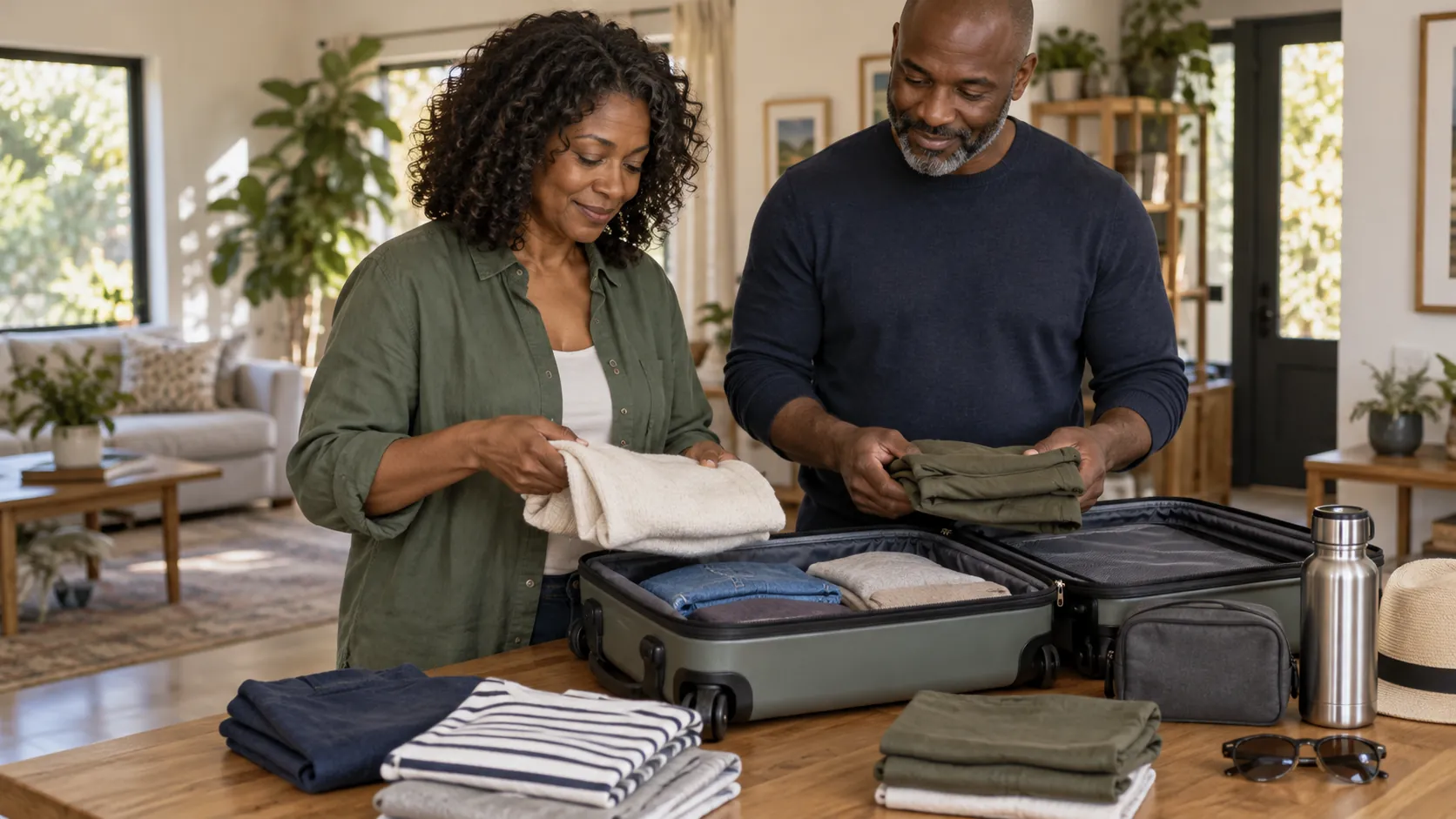
A suitcase can close successfully and still be difficult to travel with. The problem may not appear until you reach the stairs, try to place it in a vehicle, or need something buried beneath several layers. Packing is therefore more than fitting belongings into a container. It is planning how those belongings will move through a series of ordinary tasks, some of them performed when you are tired or in an unfamiliar place.
For travellers leaving Markham, a useful packing plan begins at home but extends to the destination. Consider the route, the transfers, the help available, and any current limitation affecting your hands, shoulders, back, or walking. You do not need a perfect minimalist wardrobe or a new luggage set. You need a bag arrangement that you can manage through the journey you have actually planned.
Draw the journey before filling the case
List the points where bags must be moved: from storage to the packing area, through the house, into transport, through a terminal or station, and into the place where you will stay. Add stairs, long corridors, and changes between vehicles where you know about them. This simple sequence can reveal a difficult transfer that is easy to miss when you think only about the main flight or drive.
Ask who will be present at each stage. A companion who can help at departure may not be available at arrival. A hotel may have an elevator, while the place you visit afterward may not. Confirm assistance and access details with the relevant provider instead of assuming they will work the same way everywhere. If you need accessibility support, arrange it through the appropriate service before travel.
Keep uncertainties visible. If you do not know whether a route includes stairs or whether luggage storage is easy to reach, find out while changes are still possible. A small adjustment to transport or accommodation may matter more than rearranging the contents of the bag. Planning the transfers first helps you choose equipment for the real task rather than for an idealized journey.
Choose a bag you can manage when it is full
Check the luggage you already own. Look at the handles, wheels, closures, and empty weight. A roomy case can encourage packing more than you intended, while a smaller bag may become awkward if it is overfilled. The useful question is not which bag carries the most. It is which arrangement you can control, move, and access through the route you have planned.
The AAOS advice on lifting and carrying luggage recommends light, manageable luggage, thoughtful packing, and getting help with cumbersome loads. Wheels can reduce carrying on suitable surfaces, but the bag still needs to be handled at steps and transfers. Use that guidance as a reason to assess the complete task, not as a promise that a wheeled case eliminates every physical demand.
Do not confuse a carrier’s baggage allowance with your personal handling capacity. A bag can meet the travel rules and still be too difficult for you to manage. Check the current size, weight, and permitted-item requirements directly with the transport provider, then make a separate decision about what is comfortable and realistic for your circumstances. Those are two different checks.
Edit the contents before organizing them
Lay out the proposed items and identify their purpose. Start with essentials for the trip, including necessary medical items, then consider clothing and optional equipment. Look for duplicated items that were added by habit. Removing something you do not expect to use may simplify the journey more effectively than finding a clever way to compress it into a smaller space.
Think in terms of the actual itinerary. A short family visit, a work event, and an outdoor holiday call for different contents. Ask what is available at the destination and what you genuinely need to bring. Do not leave behind necessary medication, accessibility equipment, or other essential support in pursuit of a lighter bag. Instead, plan how those items will be carried and accessed appropriately.
Packing organizers can make items easier to locate, but they do not reduce the weight of what is inside them. Use them if they solve a specific problem, such as keeping a change of clothes together. Avoid adding several layers of containers simply because they create a tidy photograph. The arrangement should remain easy to open, repack, and understand after the first day away.
Set up a packing area that works for you
Choose a stable surface where you can see and reach the contents without balancing the suitcase precariously. Make sure the surface can safely support the bag and that it will not roll or slide. If placing the empty case there is difficult, ask for help or use another arrangement. Do not create a new lifting problem in order to achieve a more convenient packing height.
Gather items in smaller groups so the process does not require constant trips between distant rooms. Keep the walkway clear and set aside things that still need to be washed, charged, or checked. A short written list can reduce repeated unpacking to verify whether an item is already inside. This is especially useful when several household members are packing in the same area.
Allow time to pause. Packing late at night under deadline pressure can turn small inconveniences into rushed handling decisions. Start with the items that can be prepared early and leave a clear space for last-minute essentials. You do not need to finish the entire case in one uninterrupted session if spreading the work across manageable periods suits you better.
Put access needs ahead of perfect symmetry
Think about what you will need during the journey, not only after arrival. Tickets, identification, permitted medications, communication devices, and other essentials should be organized according to the applicable travel rules and your needs. Keep private documents secure. Avoid an arrangement that requires opening a large suitcase in a crowded space every time you need one small item.
Choose the location of frequently used items deliberately. A pocket is useful only if you can reach it without losing control of the rest of the bags. If you use a separate personal bag, consider the combined handling task. A light suitcase plus several smaller bags can still become awkward when one hand is needed for a rail, a mobility aid, or assisting a child.
Try the sequence at home without forcing a difficult lift. Can you retrieve the necessary item, close the bag, and continue? Can you identify the correct compartment without emptying everything? This kind of rehearsal tests the organization rather than your maximum strength. If the arrangement is cumbersome, change it while you have time and space to do so.
Plan the lifts you cannot remove
Some transfers may still require lifting, even with wheeled luggage. Consider the bag’s size, grip points, distance from you, and destination before attempting the task. Clear the route and avoid rushing. The Canadian Centre for Occupational Health and Safety’s lifting guidance emphasizes the load and environment as well as the person performing the lift. Reducing the demand or arranging help can be more useful than trying to perfect one technique for an unsuitable load.
If a bag is beyond what you can manage, obtain assistance or change the arrangement. Do not use an overhead compartment as a test of whether a painful shoulder has recovered. Ask the transport provider about available options in advance, and do not assume staff can perform every lift for you. Any assistance should be agreed through the appropriate service rather than discovered only when boarding has begun.
For a car journey, decide where each item will go before loading. Keep essential travel items accessible without compromising vehicle safety. Ask another person to handle a transfer that conflicts with your current restrictions. A lighter load, a different bag arrangement, or a second trip may be practical options depending on the setting, but none should create an unsafe route or an unsecured load.
Share responsibilities clearly
Travelling with another person can make handling easier when the arrangement is explicit. Agree on who manages each bag and who keeps track of essential items. Avoid assuming that the strongest-looking person can comfortably handle everything. Their own needs, fatigue, and other responsibilities matter too. A shared plan should remain manageable for each person at every transfer.
Consider a hypothetical family leaving for a weekend visit. One adult may organize the documents and accompany a child while another manages a single wheeled case. If the group later separates, the bags may need to be redistributed. Thinking through that change beforehand prevents a convenient departure arrangement from becoming impractical at the return journey.
If you are travelling alone, keep the number of separate pieces realistic for the route. Arrange help where needed and allow time to use it. There is no benefit in packing a system that works only when someone unexpectedly volunteers. A plan you can rely on is more useful than one that assumes every transfer will happen without delay or difficulty.
Account for a current injury or recurring symptoms
If you have been given lifting, carrying, or movement restrictions, include travel in the discussion with your clinician. Describe the bag, the transfers, and the assistance available. Ask what needs to change rather than requesting a general statement that travel is fine. The transport itself may be only one part of the physical demand.
Do not remove prescribed support or ignore a restriction to make a bag easier to carry. If pain, weakness, or altered sensation affects your control, seek advice and revise the plan. For broader journey comfort, our article on long-flight movement and comfort in Markham discusses a different part of travel preparation. Packing and the time spent in transit should be considered together when planning a demanding trip.
Leave room for the return journey
The bag will need to come home, possibly with additional items and less orderly packing. Leave enough flexibility that you are not forced to carry an extra loose load because the case was completely full on departure. Keep a simple record of what proved useful and what remained untouched. That information can make the next trip easier to prepare without requiring an entirely new packing system.
At home, unpack in a manageable sequence and arrange help with lifting luggage back into storage if needed. If recurring discomfort is making travel tasks difficult, contact Prime Spine in Markham to discuss assessment and appropriate support. A practical travel plan considers every transfer, keeps essential items accessible, and gives you a bag arrangement that serves the trip rather than dominating it.