
A difficult phrase can absorb your attention so completely that an entire evening disappears into repetition. You begin intending to solve a musical problem and finish with a stiff neck, tired forearms, or a hand that feels less cooperative. The next day, you may be unsure whether to practise again, change your technique, or take a complete break.
Musicians in Markham include adult beginners, students preparing for an examination, community ensemble players, and people whose work depends on performing or teaching. Their schedules differ, but they share a practical challenge: making progress without ignoring symptoms. A useful practice plan combines musical judgment with attention to setup, session demands, and timely healthcare advice. No single chair position or stretching routine can answer all of those questions.
Give the session a musical purpose before adding minutes
Start by deciding what you want to learn. Perhaps you need to identify an unfamiliar rhythm, choose fingering for a short passage, or understand how your part fits the ensemble. Each task invites a different kind of work. An undefined goal such as practising more makes it easy to continue long after concentration has faded.
Write the goal in a sentence and decide what would count as useful progress today. You might mark a troublesome transition for discussion with your teacher rather than trying to perfect it alone. This approach makes the session easier to stop or adapt. It also gives you something meaningful to record besides total time at the instrument, which cannot show whether the practice was focused, varied, or appropriate for your circumstances.
Include preparation that is separate from demanding playing
The British Association for Performing Arts Medicine distinguishes general physical preparation from simply beginning to play. Its Don’t Cramp Your Style resource discusses comfortable warmup movements and avoiding painful or forced movement. If you have an injury or symptoms, ask a clinician which preparation is suitable instead of adopting a routine because another musician recommends it.
Make the practical setup part of that preparation. Place the music where you can see it, clear unnecessary objects, and arrange any pedals, cables, or accessories before you begin. Finding a pencil or changing the height of a stand should not require balancing an instrument awkwardly. A few organizational decisions can make it easier to focus on the music once the session starts.
Look at the relationship between you and the instrument
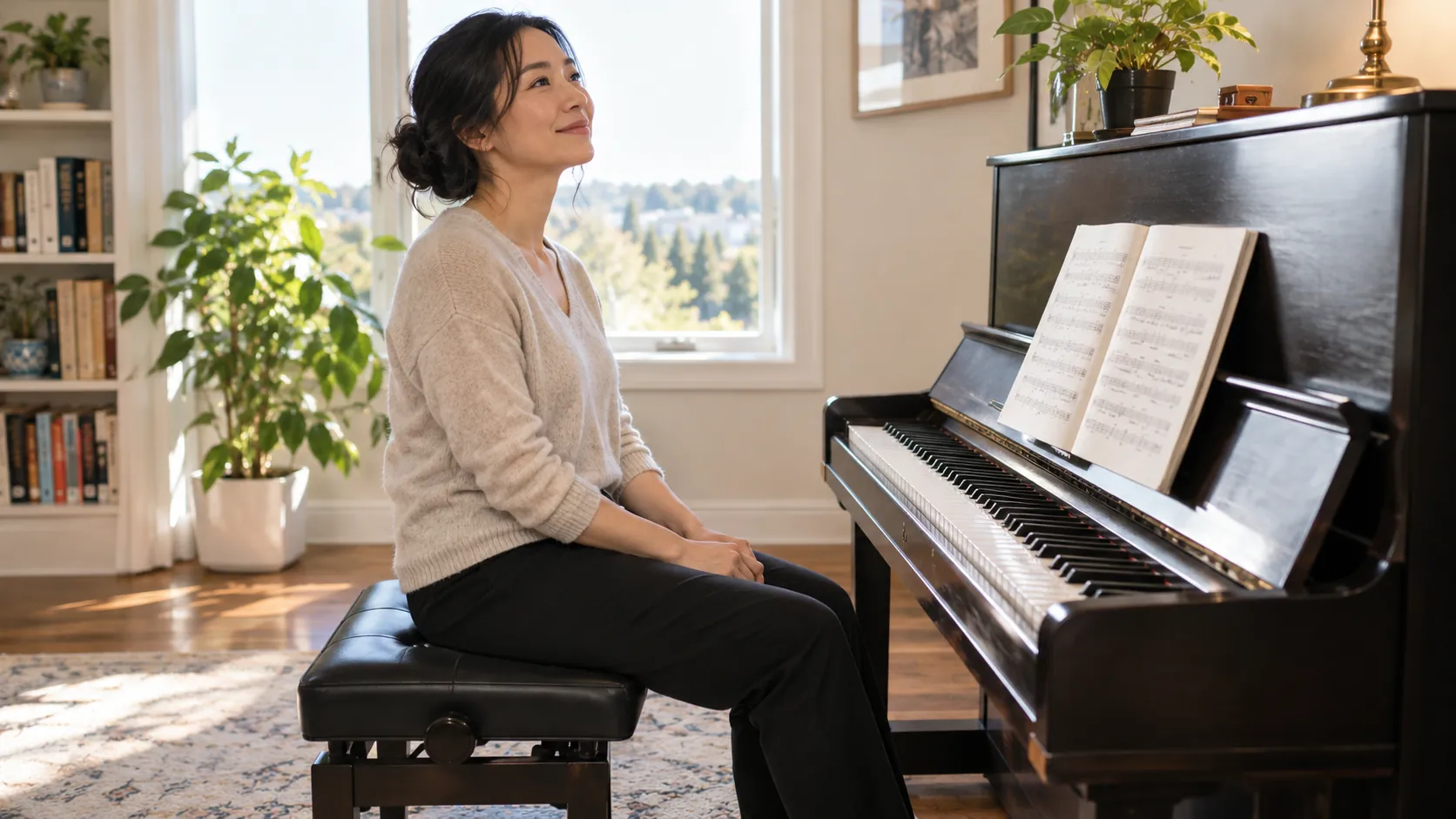
A piano bench, violin support, guitar strap, or music stand affects the task you are trying to perform. Discuss the setup with a knowledgeable teacher, especially if you have recently changed instruments or moved to a different practice space. Ask them to explain the purpose of an adjustment rather than copying the appearance of another player’s position.
If symptoms are involved, include a healthcare professional in the conversation. Technique instruction and clinical assessment answer different questions and can complement one another. A teacher may notice that you struggle to reach a passage comfortably, while a clinician evaluates the symptoms and function. Avoid expecting either person to infer the entire situation from a still photograph that captures only a moment of a much longer session.
Make the music readable without chasing the page
Notice whether you repeatedly lean toward small print, twist to see a shared score, or look far to one side at a screen. Try to identify the specific obstacle: text size, lighting, stand placement, or a device that keeps dimming. Solve one problem at a time so you can tell whether the adjustment is useful.
A larger print copy, an appropriately positioned stand, or a change in lighting may be a practical option. Follow copyright and access rules when obtaining or adapting sheet music. If visual difficulty persists beyond a particular score, arrange suitable eye care rather than compensating indefinitely with a strained position. The aim is to make information accessible while preserving the instrument setup you and your teacher have considered.
Break a stubborn passage into a clearer learning task
Repeating a passage from beginning to end may conceal where the difficulty actually lies. Ask your teacher how to isolate the relevant transition, simplify the task, or work on the rhythm separately. These are musical decisions, and the right choice depends on the instrument and material. A focused question can be more productive than another uninterrupted sequence of attempts.
Notice what happens when frustration rises. You may speed up, grip harder, or stop listening carefully to the result. Treat that moment as a cue to reassess the task rather than prove your determination. Mark the passage, move to a different kind of study if comfortable, or end the session as appropriate. Pain or altered sensation should not become the price you expect to pay for learning a difficult piece.
Use pauses that are easy to remember
Choose natural points in the practice plan where you will put the instrument down or step away. These could follow a particular section of work rather than an arbitrary demand to finish the whole piece. If you lose track of time, a gentle reminder may help, provided it does not become another distracting task to manage.
What happens during the pause matters practically. Set the instrument down safely and change the activity instead of immediately moving to another task that troubles the same area. There is no universal interval that guarantees comfort or prevents injury. If symptoms are present, ask for individual guidance about session length, breaks, and when to stop. Use those instructions rather than extending a session simply because you have not reached a target number of minutes.
Count rehearsals and teaching as part of the week
Private practice is only one part of a musician’s schedule. Lessons, rehearsals, demonstrations for students, recording attempts, and carrying equipment can occupy the same day. Write these commitments in one place before deciding how much additional work to schedule. A quiet practice day may still be physically demanding if it includes repeated demonstrations or a long performance.
Tell your teacher or ensemble leader when the schedule changes substantially. An extra rehearsal may require reconsidering what you do alone that evening. BAPAM’s discussion of programme choice when returning to performance highlights the importance of matching repertoire and performance demands to preparation. This is especially relevant after a break, when the calendar can fill faster than a sensible return plan develops.
Keep musical learning available during a physical setback
An injury can feel threatening because it interrupts both a routine and a source of identity. Ask what musical activities remain appropriate while you follow the clinical plan. BAPAM’s return-to-playing guidance discusses a gradual, structured return and options such as studying scores, listening analytically, and mental practice. These approaches can preserve engagement while physical playing is limited.
Choose alternatives that fit your needs and do not recreate the same symptoms through another task. Long computer editing sessions, for example, may not be a useful substitute if using the mouse also troubles your arm. Discuss practical options with your teacher and clinician. The goal is to maintain a connection to music while respecting the boundaries of the recovery plan, not to fill every removed playing minute with another demanding activity.
Describe symptoms in language that helps the assessment
Record the instrument, the task, and the timing. Does discomfort appear during a particular technique, after a rehearsal, or when carrying the case? Which area is affected? Is it aching, tingling, numbness, or a loss of control? Mention symptoms during non-musical activities as well, because the instrument may be only one part of the pattern.
Persistent pain, recurrent numbness, weakness, or a change in hand control warrants professional assessment. Do not diagnose the problem from the name of a common musician’s injury. Our guide to elbow tingling and cubital tunnel symptoms in Markham describes one possible nerve-related pattern, but a musician can have many different causes of discomfort. A clinician should evaluate the findings and advise on further care when needed.
Bring the right details to a lesson or appointment
If appropriate, ask whether bringing the instrument or a short recording of ordinary playing would help. Check this before arriving, especially with large equipment. A recording should show the usual setup and task without deliberately provoking pain. Explain what you want the viewer to understand, such as the position of a stand or the movement that becomes difficult.
Prepare separate questions for each professional. A teacher can help with fingering choices, repertoire, and technical demands. A clinician can discuss symptoms, examination findings, and a plan for activity or treatment. Share recommendations between them with your consent when useful. This reduces the chance that you receive two plans based on different assumptions about how much and how intensely you are playing.
Plan the practical details of performance day
A performance involves more than the minutes on stage. Consider transportation, carrying the instrument, waiting, warmup access, rehearsal, and the performance itself. Ask about the available chair or stand when the setup matters to you. Arriving early enough to make permitted adjustments is easier than trying to solve everything while others wait to begin.
If you are returning after an injury, discuss the full schedule with the clinician overseeing your care. Agree on how you will communicate any limits to the organizer. Do not promise an unrestricted performance before those questions are resolved. An honest conversation about a shorter role or a changed programme is easier to manage in advance than a last-minute decision made while symptoms are increasing.
Keep comfort connected to the reason you play
Music can be a profession, a serious study, or a valued hour at the end of the day. Your plan should acknowledge that meaning. Tell your healthcare professional what you hope to return to and what you are worried about losing. Tell your teacher what the clinical advice allows so that musical goals can remain realistic and engaging.
For a musculoskeletal concern, you can contact Prime Spine to ask about arranging an assessment and whether the clinic is a suitable starting point. This article provides general education and planning ideas, not a diagnosis or a personalized practice prescription. A thoughtful session leaves room for learning, adjustments, and attention to symptoms so that progress remains connected to the enjoyment and purpose of making music.