
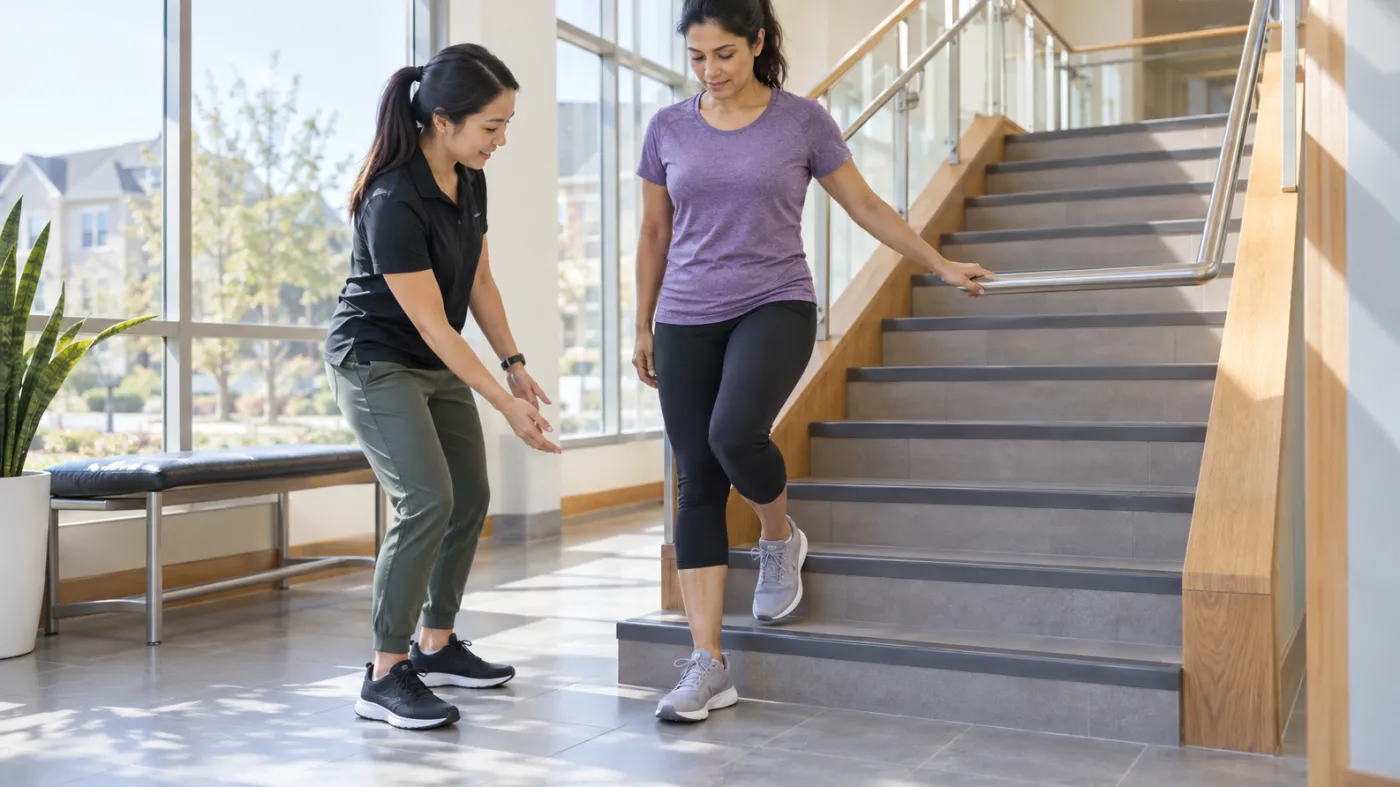
Knee pain on stairs can turn a routine part of the day into a repeated negotiation. Going down to the basement, climbing to an office or using a transit station may feel manageable once but increasingly uncomfortable after several trips. Some people begin leading with the same leg on every step or pulling heavily on the handrail without realizing how much the pattern has changed.
Stairs ask more of the knee than level walking. The thigh muscles control the body as it lowers and generate force to lift it upward. The knee bends farther, and the joint behind the kneecap experiences more load. That demand is normal; pain often appears when the current demand exceeds the capacity available on that day or over that week.
For residents experiencing knee pain on stairs in Markham, the goal is not simply to avoid every staircase. A useful plan identifies the likely pain pattern, rules out concerns that need medical care, modifies the aggravating dose and gradually rebuilds the strength and confidence required for everyday steps.
Front-of-knee pain is common but not identical for everyone
Pain around or behind the kneecap is often described as patellofemoral pain. It may appear with stairs, squats, running, hills or prolonged sitting. The name describes a clinical presentation rather than one damaged spot that can always be seen on a scan.
Other conditions can produce similar symptoms. Patellar or quadriceps tendon pain may be more localized and respond differently to jumping. Osteoarthritis may involve stiffness and changes across the joint. A meniscal injury, ligament injury, referred pain from the hip, or inflammatory condition may require different reasoning.
This is why a diagnosis should not come from the sentence “stairs hurt.” The onset, exact location, swelling, movement and health history all matter. The same staircase can expose several different problems.
Notice whether up or down is harder
Descending often feels more difficult because the quadriceps must control the lowering body while the knee moves into more bend. Ascending demands force to lift the body. This difference can help guide assessment, but it does not prove which tissue is responsible.
Record where the discomfort begins. Does the first step hurt, or only the third flight? Is there a sharp catch, a broad ache or a feeling of weakness? Does the knee swell later that day? Can level walking continue comfortably?
Also note recent changes. A new home with more stairs, a return to commuting, extra running hills or a sudden increase in squats can raise the weekly knee load. Sometimes no single step was harmful; the total number and intensity of repetitions changed faster than the knee adapted.
Know when to seek prompt assessment
After a significant injury, seek timely medical care if the knee is visibly deformed, cannot bear weight, rapidly swells or feels locked in a position. A true locked knee means the joint cannot fully bend or straighten because movement is mechanically blocked, not simply that it is painful or stiff.
A hot, red and markedly swollen knee with fever requires urgent medical assessment. Sudden calf swelling, unusual warmth or colour change, chest pain or shortness of breath can indicate a vascular problem and should not be treated as ordinary knee pain.
Progressive weakness, unexplained symptoms in several joints or pain accompanied by systemic illness also deserves medical evaluation. These warning signs are not meant to make every knee click alarming. Clicking without pain is common; the overall presentation determines concern.
What a knee assessment may include
The clinician should begin with the history: onset, location, swelling, past injury, activity changes and goals. They may observe walking, a squat, a step-up and a step-down. The point is not to judge movement as good or bad from appearance alone, but to see what reproduces symptoms and how the person distributes load.
Strength at the knee and hip may be tested. Ankle motion can matter because limited forward movement of the shin may alter a step or squat. The clinician may examine swelling, joint range and tenderness, then screen the hip or lower back if symptoms suggest referral.
A useful assessment ends with a working explanation and baseline measures. That might include the number of stairs tolerated, a timed chair-rise task or a questionnaire. Without a baseline, it is difficult to know whether a program is improving function or simply changing exercises.
Imaging is useful when it changes the decision
An X-ray may help when osteoarthritis, fracture or another bone-related concern is suspected. MRI can provide more detail about soft tissues, but it is not a routine requirement for every case of front-of-knee pain.
Structural findings can exist without matching symptom severity. An image does not show how well the leg controls a step or how much training changed recently. For many non-traumatic presentations, a clinical assessment and trial of appropriate conservative care come first.
Ask what a proposed image is expected to clarify. Imaging is valuable when the answer affects treatment, referral or surgical planning; it is less useful when it delays a safe plan without changing it.
Reduce the dose without abandoning the task
During an irritable phase, change how often, how deeply or how quickly the knee is loaded. Use an elevator for several trips while keeping one tolerable flight for practice. Take smaller steps where safe, slow the descent and use the rail to share load rather than pulling the body entirely with the arms.
At home, group tasks to reduce unnecessary trips for a few days. This is not permanent avoidance. It creates space for symptoms to settle while strength work begins.
Pain response should guide the dose. Mild discomfort that remains stable and returns to baseline soon after activity may be acceptable. Increasing pain with each repetition, new swelling or a flare lasting into the following day suggests that the current amount is too high.
Start strength below the most painful level
If a full staircase is too provocative, begin with movements that train similar muscles at a lower demand. A sit-to-stand from a higher chair, a shallow supported squat or a low step-up may be suitable. The exact choice depends on which direction and depth are tolerated.
Use a stable surface and move slowly enough to maintain control. The knee does not need to remain perfectly behind the toes; allowing it to move forward is part of normal stair climbing. The important question is whether the range and load are appropriate for the current stage.
Begin with a number of repetitions that could be performed again with similar quality. Leaving a few repetitions in reserve often supports consistency better than exercising to exhaustion. Strength sessions can then be spaced to allow recovery.
Train both the knee and hip
The patellofemoral pain clinical practice guideline supports combined hip- and knee-targeted exercise for many people with this presentation. Knee-focused work builds the quadriceps that control the step. Hip exercises can develop the strength needed to manage the pelvis and thigh during single-leg tasks.
Options may include squats, step-ups, knee extensions, bridges, side steps or hip abduction work. No single exercise is mandatory. A program should use movements the person can perform, progress and connect to their goals.
Do not turn “hip strength” into a claim that the knee hurts because the gluteal muscles are asleep or the leg alignment is broken. Strength is adaptable capacity. The exercise is there to prepare the person for load, not to correct a defective body.
Progress step-down control deliberately
Descending is often the last stair task to feel comfortable. Practise from the lowest available height beside a rail or stable support. Lower the opposite heel toward the floor, then return. The working knee can travel naturally while the foot remains planted.
Change one variable at a time. A slightly taller step increases range; an added weight increases force; more repetitions increase volume. Speed and reduced hand support add further challenges. If all are changed together, a flare provides little information about what exceeded tolerance.
Eventually, practise consecutive steps because one isolated step does not reproduce a full flight. A clinician may also introduce carrying a light object or changing pace when those demands reflect daily life.
Manage running, squats and sport while stairs recover
Knee load comes from the whole week. A runner who reduces stairs but keeps a new hill workout, two lower-body gym sessions and a weekend tournament may not have reduced much at all. Map the combined demand.
Temporarily shorten running distance, choose flatter routes or use run-walk intervals if running increases the same pain. In the gym, adjust squat depth or resistance, then rebuild. Avoid testing the painful movement at full intensity every day.
Maintain activities that are comfortable. Cycling with an appropriate seat setup, level walking or upper-body training may preserve fitness. The alternative activity should not be assumed safe merely because it is different; judge it by the knee’s response.
Consider footwear without expecting a cure
Shoes influence comfort and how force is distributed, but they are only one part of the plan. A stable, comfortable shoe that suits the activity is a reasonable starting point. Replace footwear when the upper or sole no longer secures the foot, not because a fixed kilometre count guarantees injury.
Some people with patellofemoral pain may benefit from prefabricated foot orthoses for a limited period, particularly when an assessment identifies a likely responder. They should be used alongside exercise rather than presented as permanent structural correction.
Knee taping may provide short-term symptom relief for selected people. It can create a more comfortable window for exercise, but it does not rebuild strength by itself. Stop if it irritates the skin or increases symptoms.
Make work and home stairs safer during a flare
Keep the staircase well lit and free of objects. Use a secure handrail. Rushing, carrying a load that blocks the view and using socks on a slippery surface can add risk when the knee already feels uncertain.
If one side is substantially more painful, a temporary “up with the stronger, down with the more sensitive” step-to pattern may help. This is a short-term strategy, not the end goal. Return toward a reciprocal pattern as strength and comfort improve.
When carrying laundry or groceries, use smaller loads so one hand can remain available for the rail. At work, discuss temporary task or route changes if repeated flights are a major part of the day.
Do not mistake every sound for damage
Knees click, pop and grind for many reasons. Joint surfaces, tendons and gas changes can all create sound. Noise without pain, swelling or loss of function does not necessarily need treatment.
Painful catching after injury, repeated giving way or locking is different and should be assessed. The sound itself is less informative than what happens with it.
Fear of harmless noise can lead to stiff, guarded stairs that feel harder. Education is therefore part of rehabilitation: the knee can be sensitive without being fragile.
Measure progress with function
Choose a repeatable stair measure. Count how many steps can be climbed at a comfortable pace, rate confidence descending or note whether the rail is needed. Test at planned intervals rather than several times a day.
Strength measures also matter. A deeper controlled sit-to-stand, a lower chair or a higher step may show increased capacity. Pain may fluctuate while these abilities improve.
Recovery is not always linear. A busy week, poor sleep or an unexpected amount of walking may increase symptoms temporarily. Return to the last tolerated dose instead of assuming all progress is lost.
When the plan needs revision
Reassessment is appropriate if swelling persists, motion decreases, giving way becomes frequent or the knee does not improve despite a consistent graded program. The initial diagnosis may need review, the exercise dose may be too low or high, or another health factor may be influencing recovery.
Medication and injections should be discussed with a physician or pharmacist who understands the person’s health history. Passive treatments may reduce symptoms, but lasting stair confidence generally requires practice and capacity.
A practical next step in Markham
For one week, record the number of stair trips, other lower-body activity and the knee’s same-day and next-day response. Bring this record to an assessment along with your most important goal. “Use the stairs to my apartment without pulling on the rail” is more actionable than “fix my knee.”
Knee pain on stairs does not mean stairs are permanently harmful. A thoughtful plan reduces excessive demand, builds leg strength and gradually returns the exact task. With time, every step can become an ordinary part of the day again rather than a repeated test.