
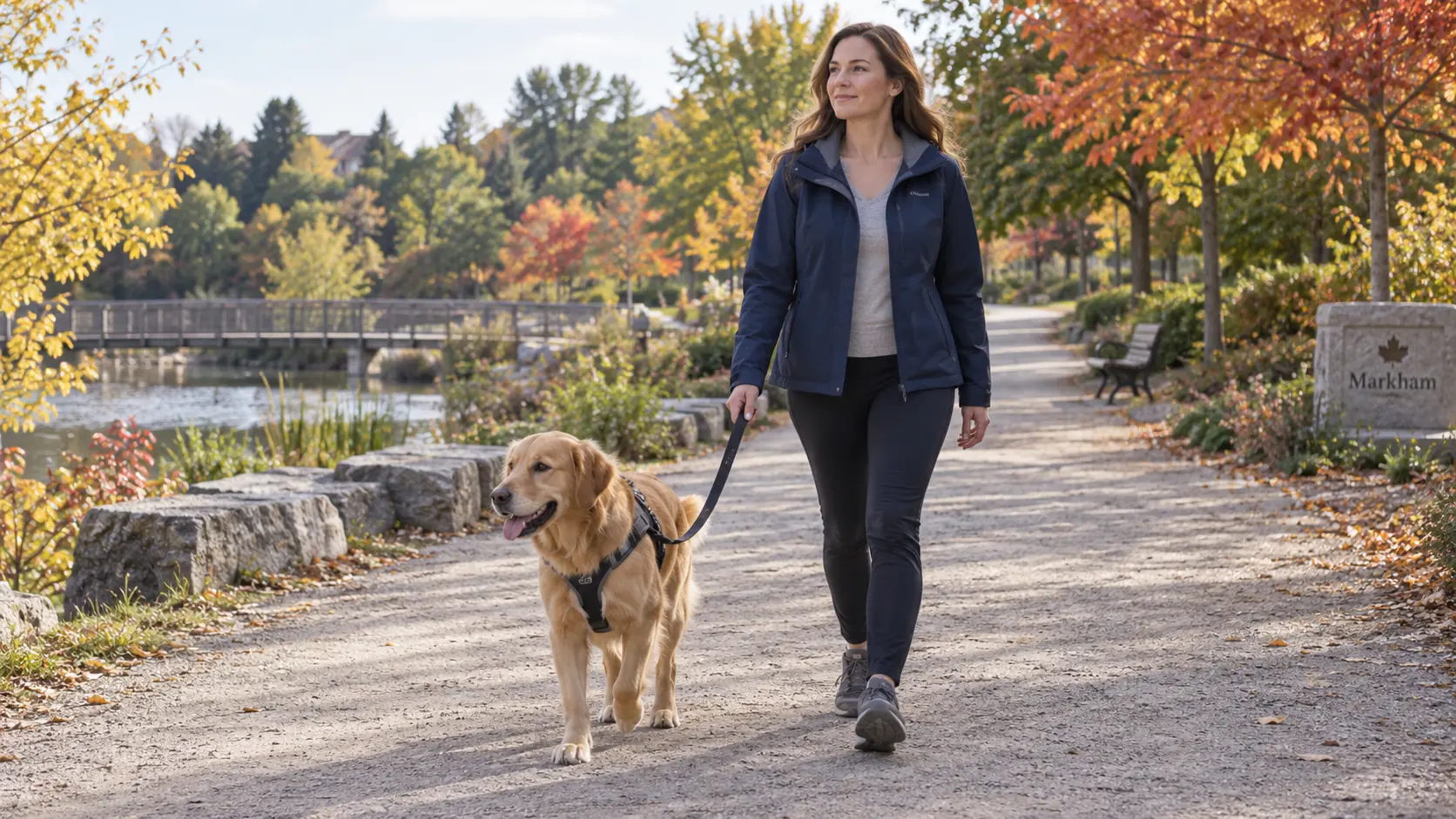
The walk often starts before you reach the sidewalk. There are shoes to put on, a leash to find, a door to open, and a dog who may be much more ready to leave than you are. Add a coffee, a phone, a sore wrist, or a slippery step, and an ordinary routine can become surprisingly awkward. Improving the walk may begin with changing those first few minutes.
Dog owners in Markham have different needs: a short outing before work, a slower trip with an older dog, or a longer recreational walk when time allows. This article focuses on making the human side of that routine more manageable. A veterinarian or qualified trainer can advise on your dog’s health, equipment, and behaviour. Persistent pain or a new injury in your own body needs appropriate assessment rather than a stronger determination to finish the usual route.
Give the departure a little structure
Keep the items you regularly need in a consistent place near the exit. Prepare waste bags and clothing before attaching the leash if that is practical for your household. This reduces the number of tasks you must complete while also controlling an excited animal. Clear loose footwear and other obstacles from the route to the door, especially where you need to turn or step down.
Consider what makes departure difficult on your busiest day. Perhaps the leash is stored beneath several bags, or the only place to sit while changing shoes is across the room. A small rearrangement may help more than buying new walking equipment. Make the setup easy for anyone who shares the responsibility so that you do not need a different process each time another family member takes the dog out.
If you are managing a painful joint or recovering from an injury, explain the departure routine to your clinician. Attaching a clip, opening a heavy door, and controlling a dog at the same time may matter as much as the walking distance. You can then ask about the specific task that is difficult rather than receiving advice aimed only at walking on level ground.
Avoid making your hand part of the leash
The American Society for Surgery of the Hand’s leash-safety guidance advises against wrapping a leash around fingers or the hand. It also recommends a manageable leash suited to your hand and emphasizes training to reduce pulling. A sudden tug can become much harder to respond to when a loop tightens around you. Ask a qualified trainer to demonstrate handling appropriate for your dog and equipment.
Do not assume that an elaborate handle or attachment automatically solves discomfort. Think about whether you can hold it comfortably, operate any mechanism, and maintain control without juggling other objects. If a previous injury limits grip or arm use, obtain individual advice before resuming leash handling. Walking without a dog and handling a dog that may change direction suddenly are different tasks, even on the same familiar path.
The Hand Society also describes falls and hand injuries associated with leashes. This does not mean you should give up an activity you enjoy. It does mean that repeated pulling, tangled lines, or difficulty controlling the dog are worth addressing directly. Equipment and training decisions should help the whole situation become manageable rather than asking your hand or shoulder to absorb the same problem on every outing.
Carry fewer competing objects
A phone, keys, drink, shopping bag, and waste bags can quickly occupy the attention and space needed for leash handling. Decide what actually needs to come on the walk and where it can be stored securely. A pocket or suitable bag may free your hands, provided it does not interfere with movement or create another loose item to manage. Test the arrangement at home before relying on it outside.
If you need to answer a message, stop somewhere safe and make sure the dog is under control first. Avoid combining the walk with errands that leave you carrying more than you can comfortably manage. A separate trip for groceries may be simpler than trying to make one outing serve every purpose. Convenience is only useful when the combined task remains practical for both you and the dog.
Plan how you will handle waste collection without rushing. Keep supplies accessible and arrange help if bending or hand use is restricted by your care plan. If an assistive tool is being considered, discuss whether it suits your situation and can be used while maintaining control of the dog. The solution should cover the entire task, including securing and disposing of the bag, rather than only the first movement.
Choose a route with options
Distance is just one feature of a walk. Consider the width and surface of the path, crossings, lighting, places to pause, and how easily you can turn back. A route that works well on a quiet morning may be more demanding when crowded. Before heading out, choose an option suited to the conditions and your current comfort instead of treating the usual loop as an obligation.
For a shorter outing, it can help to stay closer to home rather than walking straight away from it until you are ready to return. That gives you more flexibility if you need to stop sooner. Do not rely on a particular bench being free or a usual shortcut being open. Having an alternative in mind makes it easier to change the plan without turning the last part of the walk into a struggle.
Check the City of Markham’s leash and off-leash information and follow posted rules. Dogs must be leashed on public property and in parks except in designated off-leash areas. An off-leash park has its own requirements and is not automatically a suitable substitute when you are having difficulty managing a walk. Consider supervision, entrances, other dogs, and your ability to respond throughout the visit.
Match the outing to the day you are having
A dog walk may be one part of a physically busy day. You might already have spent hours standing, completed a workout, or carried equipment at work. When planning recreational distance, include those other demands. If you have been given activity limits, ask how dog walking fits within them and what assistance you should arrange when your own capacity is temporarily reduced.
The dog’s needs still have to be met, so changing your walk may require another person rather than simply skipping care. Identify family members, neighbours, or a suitable professional service who can help before the need becomes urgent. Discuss the dog’s routines and any handling considerations clearly. A dependable backup can reduce the pressure to complete a walk when you are injured, ill, or unable to manage safely.
For households with several walkers, keep the handover simple. Note whether the dog has already been out, whether there was an unusual difficulty, and which supplies need replacing. This helps prevent uncertainty from producing an unnecessary extra outing or a rushed departure. Shared care works best when the information needed for the next walk is easy to find and does not depend on one person remembering everything.
Make changes in the environment work for you
Weather and seasonal conditions can alter a familiar path. Wet leaves, ice, poor visibility, and uneven ground deserve attention before you commit to a route. Choose footwear appropriate to the surface and consider a different time or location when conditions are unsuitable. If you cannot manage the conditions while controlling the dog, arrange help. Our article on winter walking and slip prevention in Markham explores related planning in more detail.
Allow extra time when you know the outing will be slower. A walk squeezed into the final few minutes before leaving for work encourages shortcuts and hurried handling. Preparing earlier, sharing the task, or changing the schedule may be more effective than trying to walk faster. The same principle applies when returning home: leave space for drying paws, removing equipment, and putting away supplies without treating those tasks as an afterthought.
Be realistic about social stops as well. A conversation with a neighbour may be enjoyable, but standing in a cramped place with dogs and leashes crossing can become awkward. Choose enough space, stay attentive, and move on when the situation is no longer manageable. You can keep the social part of the routine while being thoughtful about where and how it happens.
Respond to pain as information, not a challenge
If discomfort repeatedly appears during a walk, note the circumstances. Is it related to gripping, a sudden pull, time on your feet, or something that happens afterward? Bring that description to an assessment. Avoid assuming that all hand pain is a tendon problem or that all shoulder discomfort comes from posture. The pattern helps guide questions, but it does not establish a diagnosis by itself.
After an injury, severe wrist pain, inability to move the wrist or hold objects, an altered shape or colour, or loss of feeling needs urgent medical attention. Persistent or recurring symptoms also deserve review. These warning signs are described in the NHS wrist-pain guidance. Arrange someone else to care for the dog while you obtain help rather than testing whether you can finish the walk first.
If a clinician has prescribed a brace, exercise plan, or temporary restriction, ask specifically about leash handling. A brace does not necessarily make it safe to manage a sudden pull. Returning to a short walk as a passenger alongside another handler may be different from taking full control yourself. Make the distinction explicit so the advice addresses the activity you intend to perform.
Keep what helps and revise what does not
Choose one change that addresses a real difficulty: a calmer departure, fewer objects to carry, a more flexible route, or reliable help for demanding days. Try it during normal routines and notice whether the task becomes easier to manage. You do not need to replace every piece of equipment or turn each outing into a detailed exercise session. Useful changes often come from understanding the practical sticking point.
If pain is limiting daily walks, contact Prime Spine in Markham to discuss assessment and appropriate support. Bring your description of the route, handling demands, and symptoms, along with any existing care instructions. Dog walking is both a responsibility and, for many people, a valued part of the day. A workable plan respects both sides and helps you make decisions before discomfort or uncertainty takes over the routine.