
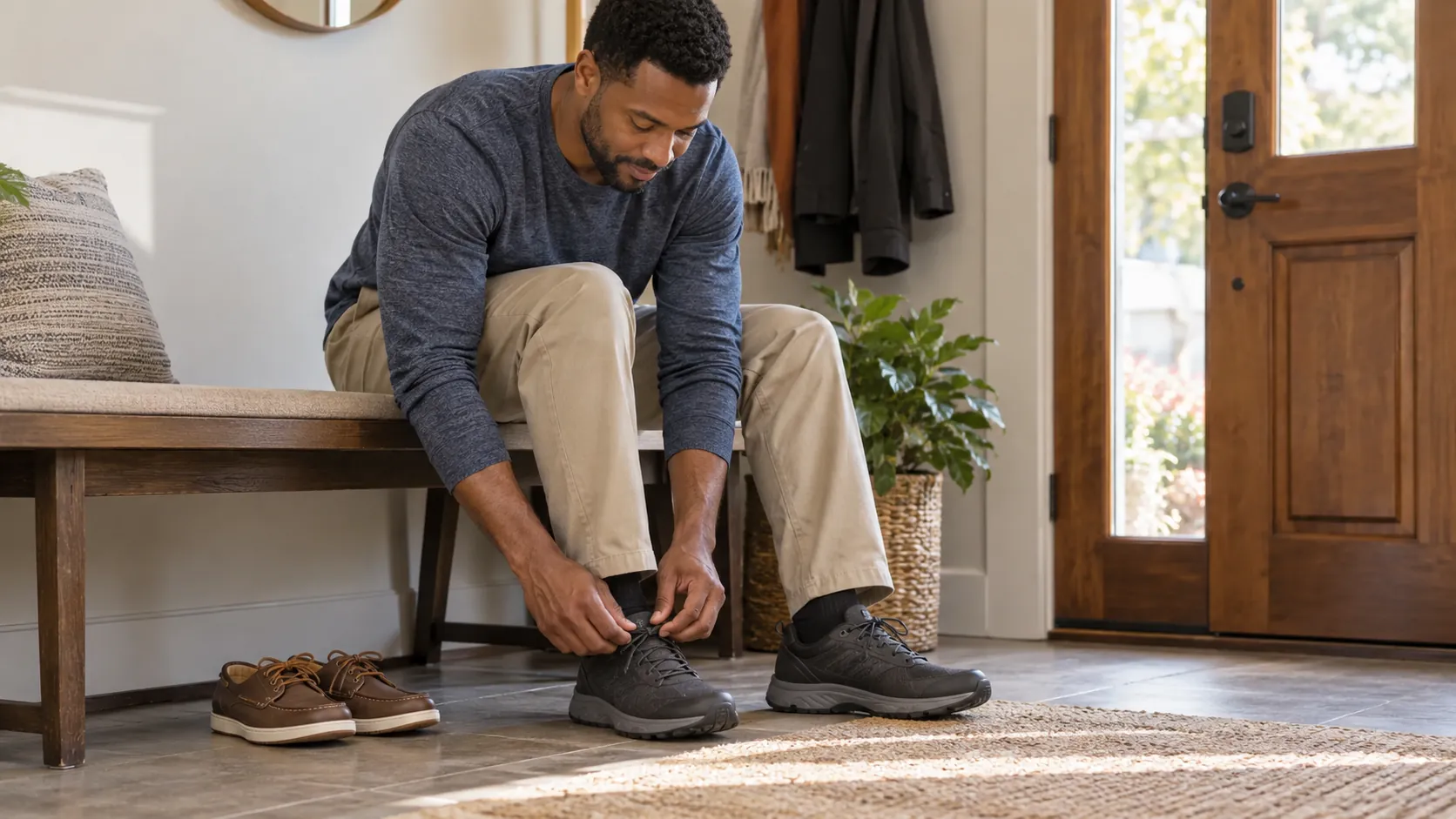
A new pair of shoes can feel promising during a short try-on and very different halfway through an ordinary day. The heel slips on stairs, the toes feel crowded after standing, or the calf notices a change that was not obvious in the shop. That does not mean every unfamiliar sensation is an injury. It does mean that the first useful question is how the shoe fits the foot and the job you expect it to do.
Changing footwear in Markham may involve moving from winter boots to lighter shoes, returning to indoor sport or replacing a worn work pair. Those are different transitions. A sensible approach considers the activity, the fit and any existing foot or ankle symptoms. It also gives you a way to evaluate the change before the shoes become part of a long day with no easy alternative.
Begin with the task, not the marketing category
Describe where the shoes will be used. A pair for short errands has a different role from footwear for a standing shift, a long walk or repeated sideways movement on a court. Athletic footwear is designed around different activity demands, and the appropriate choice should reflect the sport as well as fit. The AAOS athletic-shoe guide explains these distinctions.
Write down the main requirement before shopping. You might need a secure shoe for work that meets a safety rule, a comfortable walking pair or an indoor court shoe permitted by the facility. That simple description helps resist a purchase based mainly on a label, a discount or a friend’s enthusiasm.
If one pair is expected to serve several roles, identify the compromise. A shoe that is convenient for commuting may not be the right choice for every exercise session. You do not need a large collection, but you should understand what the chosen pair is meant to do and where its limitations might matter.
Fit is more than the number printed inside
Footwear should accommodate the shape of the foot, including width and space around the toes, while remaining secure. Both feet should be considered, and a tight shoe should not be purchased on the assumption that it will stretch into an appropriate fit. The Canadian Centre for Occupational Health and Safety provides practical fitting advice.
Use the socks you expect to wear with the shoes, and bring any prescribed insert that must fit inside. Stand and move in the pair rather than judging it only while seated. Notice pressure at the toes, the heel and the top of the foot. A size that worked in another model does not guarantee the same fit here.
Be precise when something feels wrong. A loose heel, pressure on a toe and a tight upper are different problems. Trying a different size may address one while making another worse. Explain the specific issue to the fitter instead of assuming that discomfort is simply the price of breaking in the shoe.
Make the first wear easy to interrupt
Avoid choosing a long event or an essential full shift as the first meaningful trial. When practical, begin in a setting where you can change footwear and stop the activity without difficulty. This is a way to gather information, not a universal schedule for how many minutes every new shoe should be worn.
For an illustrative example, a short familiar errand close to home may be easier to evaluate than an outing involving several hours of standing. If the shoe rubs or feels insecure, you can respond before being committed to a long return journey. Keep an appropriate alternative available when the day’s demands cannot be shortened.
Check the seller’s return conditions before the trial so you understand what is permitted. The aim is to evaluate fit honestly without creating a situation in which you feel compelled to tolerate an unsuitable pair because it can no longer be returned. A clear purchasing decision includes the practical opportunity to assess the shoe.
Change one important variable where possible
New shoes often arrive alongside a new activity goal. Someone buys a walking pair and immediately doubles the usual distance, or changes running shoes while adding hills. If discomfort appears, the footwear may receive all the blame even though the total activity changed at the same time.
Keep the first comparison reasonably familiar. Use a route, pace or task you already understand, if appropriate for your health and current symptoms. Record what changed and what stayed the same. A small amount of context makes it easier to discuss a problem with a clinician or fitter later.
This does not mean that every transition must be slow or complicated. It means avoiding unnecessary uncertainty. If the shoe is comfortable and the task is manageable, you have useful information. If discomfort appears, you can review the fit and activity without trying to untangle several major changes introduced together.
Notice the foot after the shoe comes off
Look for rubbing, pressure marks, blisters or areas that remain sore. A brief check can reveal a fit issue that was easy to overlook while concentrating on work or recreation. Do not repeatedly wear a shoe over an irritated area simply to prove that the foot will adapt.
People with diabetes, reduced sensation or circulation problems need individualized footwear advice and foot monitoring. Reduced sensation can make rubbing or pressure harder to detect. Rotherham Doncaster and South Humber NHS guidance explains why fit and inspection are especially important in this setting.
If you already receive foot care, ask how a new pair should be introduced and when to contact the service. Follow the plan given for your risk level rather than relying on a general rule that a shoe is acceptable whenever it feels comfortable. Comfort is useful information, but it is not the only consideration when sensation is altered.
Inserts need space and a clear reason
An insert changes the space available inside a shoe. A pair that fits well without it may become crowded with it, and stacking several products can alter the fit further. If an orthosis has been prescribed, ask which footwear features are needed to accommodate it and bring it to the fitting.
The Guy’s and St Thomas’ guide to choosing shoes discusses fit, toe space and accommodating insoles. The practical point is to assess the foot, shoe and insert together. Looking at each separately may miss the reason the final combination is uncomfortable.
Do not assume that adding more cushioning or support will resolve an unexplained symptom. Ask what the product is intended to change and how its effect will be reviewed. If the new combination causes pressure or a different pain, report that response rather than continuing to add another layer.
Work shoes have constraints that casual shoes do not
Required protective features, floor conditions and the length of a shift all matter. A comfortable casual pair may not be appropriate where protective footwear is required. Discuss options that meet the workplace’s actual requirements rather than replacing safety features with a general promise of comfort. CCOHS foot-comfort guidance addresses footwear within the work environment.
When raising a concern, describe the part of the shift that becomes difficult and the specific fit issue. Bring the shoes to a clinical appointment if they are central to the problem. Photographs may also help show wear or pressure points, but they cannot substitute for assessing the foot and the fit in person when needed.
Think about the whole work setup. Even a well-fitting shoe cannot provide movement opportunities that the job does not allow. Our article on standing all day at work explores how position changes and workstation design fit alongside footwear decisions.
Seasonal changes also change the activity
Switching from boots to lighter shoes may coincide with longer outdoor walks, more errands on foot or a return to sport. The transition is therefore not only a change under the foot. Review the amount and type of activity as well as the shoe when symptoms appear.
A practical seasonal plan starts with what you actually expect to do. If the first warm weekend includes a long family outing, choose footwear already known to work for that demand or plan the new pair’s trial earlier. If a return to indoor sport is the goal, evaluate the shoe in the relevant setting and follow the facility’s requirements.
Avoid treating the calendar as proof that your body should be ready for a particular volume of activity. A busy winter, an injury or time away from exercise may have changed your starting point. Adjust the plan to current capacity and seek advice when symptoms make that difficult to judge.
Do not diagnose an injury from the timing alone
Pain that begins after a footwear change may be related to fit, the activity, an existing problem or another cause. The sequence is worth recording, but it does not prove the explanation. Tell the clinician when the shoe was introduced, how much it was worn and what else changed that week.
Seek assessment for persistent pain, new numbness, weakness or symptoms that interfere with walking. Severe pain after an injury, inability to bear weight or concerning swelling and colour change needs prompt attention. People with diabetes should obtain advice about foot pain rather than waiting for a long self-directed trial. The NHS foot-pain guidance outlines reasons to seek help.
Bring both the new pair and a previously comfortable pair when practical. The comparison may help the discussion, especially if the problem appears only in one shoe. Also mention whether symptoms continue when the shoes are off. That information helps avoid assuming that another purchase is always the next answer.
Keep the decision tied to function
A successful footwear change should make the intended activity workable. You should be able to describe why the pair suits the task, how it fits and whether it remains comfortable through a reasonable trial. The most expensive or fashionable option does not answer those questions automatically.
If changing footwear in Markham repeatedly leads to discomfort, book an assessment to discuss the symptoms and whether further foot-care advice is appropriate. Bring the activity you want to enjoy back into the conversation. The goal is a practical match between your feet, the shoes and the day you need them to support.
This article offers general footwear education. Existing medical conditions, prescribed footwear and persistent symptoms require individualized advice.