
Mobility routines often begin with enthusiasm and disappear within two weeks. The plan is too long, the exercises feel unrelated to daily life, or the goal is vague: “be less tight.” When progress is hard to measure, the routine becomes one more task to skip.
A better routine begins with purpose. Mobility is the ability to move through a useful range with enough control for the task. It includes flexibility, strength, coordination and confidence. You do not need the largest possible range in every joint. You need access to the ranges that support the life and activities you value.
Mobility is more than stretching
Flexibility describes how far a joint or tissue can be moved, often passively. Mobility usually implies that you can reach and control a range yourself. A gymnast needs extreme hip and shoulder ranges. A golfer needs rotation and the ability to control it. A parent may need to get down to the floor and stand back up comfortably.
Static stretching can improve range and feel relaxing, but it is only one tool. Slow active movement, strength through a range, balance, breathing and task practice may be equally important. If the goal is a deeper squat, only stretching the hamstrings may miss ankle motion, hip strength, trunk control and familiarity with the squat itself.
The most effective routine is specific enough to matter and simple enough to repeat.
Step one: choose a real-life goal
Replace “get flexible” with a task. Examples include:
- Turn the head comfortably while checking traffic.
- Reach an overhead shelf without shoulder discomfort.
- Sit on the floor and get up with confidence.
- Squat to garden for several minutes.
- Rotate comfortably during a golf swing.
- Warm up for running without feeling restricted.
Choose one or two priorities. Too many goals create a long routine and dilute attention. Test the task gently before starting and note what limits it: discomfort, stiffness, balance, fear or lack of strength.
If the task creates neurological symptoms, sharp pain, instability or a significant functional loss, seek an assessment rather than stretching harder.
Step two: build a five-movement menu
A full-body routine can be useful, but five movements are enough to begin. Select one from each relevant category.
Spine: gentle rotation, cat-camel movement or comfortable flexion and extension.
Hips: half-kneeling hip movement, supported squat or controlled hip rotation.
Shoulders: wall slide, arm circle or light overhead reach.
Ankles: knee-over-toe rocks while the heel stays down or slow calf raises.
Integrated task: sit-to-stand, lunge, step-up, floor transfer or another movement connected to your goal.
Perform each for several slow repetitions or about thirty seconds. The entire routine may take five to eight minutes. Finish feeling as if you could do more. That makes it easier to return tomorrow.
Step three: find the right intensity
Mobility work does not need to hurt. A mild stretching sensation or manageable stiffness can be acceptable. Sharp pain, tingling, numbness, dizziness or a feeling of instability is a reason to stop and reassess.
Use a ten-point effort scale. Most daily mobility can sit around three to five: noticeable but controlled. End-range strength may feel more challenging, but technique and breathing should remain steady.
Do not force the body into a shape because a video says it is normal. Bone structure, injury history and current capacity affect range. More motion is not always better, especially in a joint that is already highly mobile and needs control.
Step four: attach the routine to an existing habit
Motivation changes. A cue is more reliable. Link the routine to something you already do:
- After brushing your teeth in the morning.
- When the coffee brews.
- At the end of the workday.
- Before the first set in the gym.
- After an evening walk.
Keep equipment visible and minimal. A mat, chair and light band are usually enough. If setup takes longer than the routine, friction will win.
Decide on a minimum version. On a busy day, one round or two minutes still counts. The minimum protects the habit; you can perform the full version when time allows.
Step five: use movement snacks
Mobility does not have to happen in one block. A few repetitions spread through the day may suit stiffness related to prolonged positions. Stand and rotate between meetings, perform ankle rocks while waiting for the kettle, or practise a supported squat after a walk.
Movement snacks also teach your body that range is part of normal life, not a special corrective event. Frequent gentle exposure may be more comfortable than one intense session after hours of stillness.
Set reminders initially, then connect the movement to natural transitions. The routine should eventually require less planning.
Step six: add strength to keep the range
New range becomes more useful when you can produce and control force there. Follow a gentle stretch with an active movement. After calf stretching, perform slow calf raises. After a hip-flexor position, practise a split squat. After shoulder mobility, use a light press or wall slide.
Move slowly and use a load that allows control. Strength training through a comfortable range can improve mobility while building capacity. It also makes the routine feel connected to function rather than a separate collection of stretches.
Two or three strength sessions per week can support broader health. Public Health Agency of Canada guidance includes muscle-strengthening activities as part of an active week. Start below your maximum and progress gradually.
A sample eight-minute routine
This general example is not appropriate for every condition, but it shows how simple a routine can be.
One minute of easy marching: Let the arms swing and gradually increase the pace.
Six gentle spine rotations per side: Stand or sit tall enough to turn comfortably without forcing the end.
Eight ankle rocks per side: Keep the heel down and guide the knee forward over the foot.
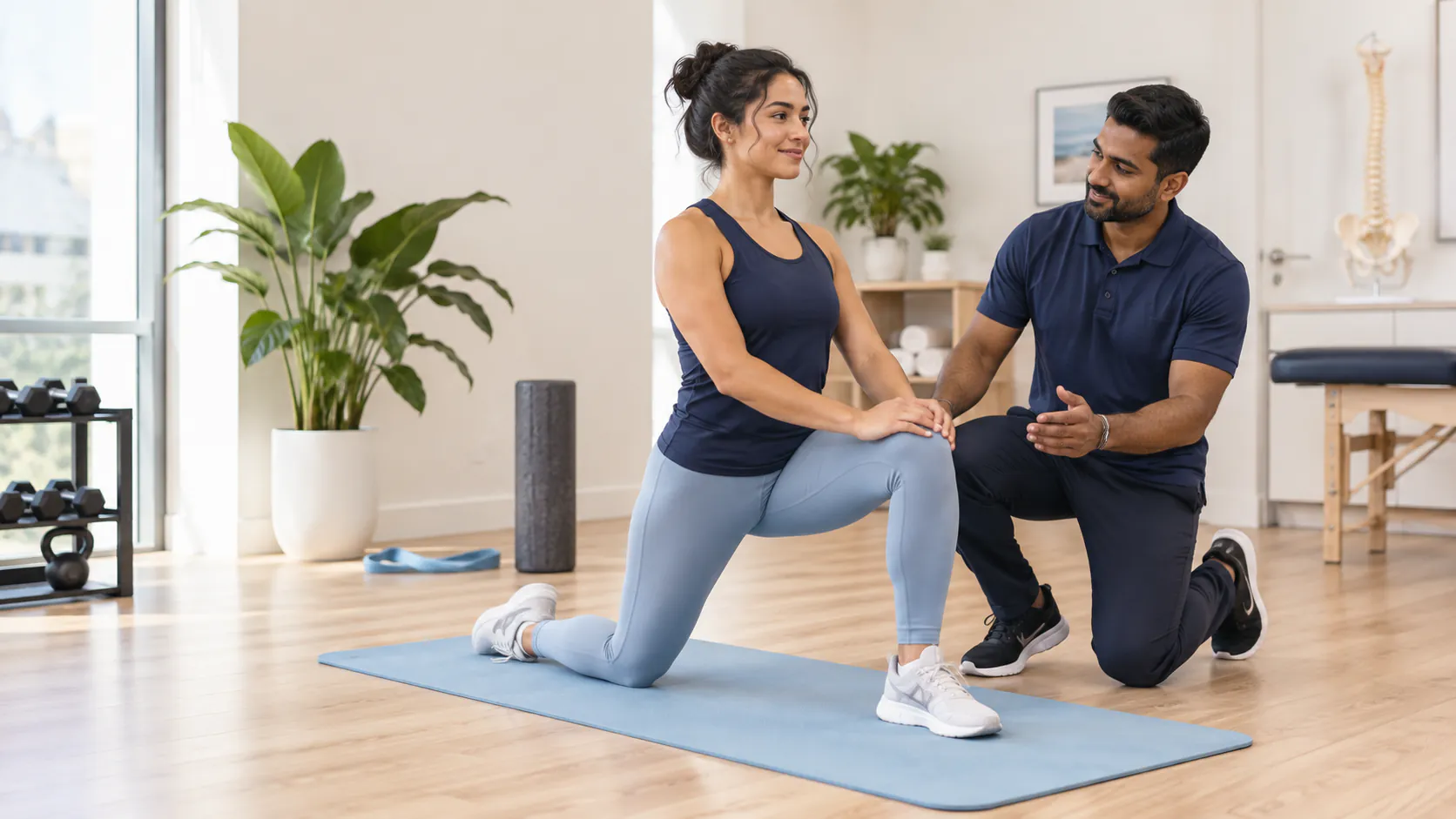
Six half-kneeling hip shifts per side: Use a cushion under the knee and lightly tuck the pelvis without squeezing aggressively.
Eight wall slides: Let the shoulder blades move naturally as the arms travel upward in a pain-free range.
Eight controlled sit-to-stands: Use a chair height that allows smooth movement and finish standing with balance.
Take normal breaths and reduce the range if symptoms increase. On a rushed day, choose the two movements most connected to your goal.
How to progress
Repeat the routine consistently for two weeks before judging it. Range can vary from day to day based on sleep, temperature, stress and activity. Look for a trend in the target task.
Progress one variable at a time:
- Add two or three repetitions.
- Pause briefly near the end of the range.
- Increase the range slightly.
- Add a light resistance band or weight.
- Use a less supported version.
- Integrate the motion into a more complex task.
If the routine has become easy but the goal has not changed, the selected movements may not address the true limit. Reassess strength, technique and the task itself rather than adding more stretches automatically.
What if you always feel tight?
The sensation of tightness does not always mean a muscle is physically short. It can reflect fatigue, protective tension, unfamiliar load, stress or prolonged position. Stretching may provide temporary relief without addressing the reason it returns.
Notice the pattern. Does tightness appear after sitting, after a hard workout or during stressful work? Does walking help? Does strengthening the area change it? The answers guide a more useful response.
For desk-related stiffness, more position variety may help more than a longer evening routine. For post-training tightness, recovery and workload may matter. For a joint that feels unstable, strengthening may be preferable to aggressive stretching.
Do not use mobility to postpone medical care
Mobility work is not a treatment for every symptom. Seek assessment for significant trauma, a joint that locks or repeatedly gives way, new weakness, spreading numbness, severe swelling, fever or progressive loss of function. Dizziness, fainting or neurological symptoms during neck movement require medical attention rather than more stretching.
Pain that persists despite reasonable modification also deserves assessment. A clinician can evaluate whether the limitation comes from a joint, muscle, nerve, injury or another health condition and can adapt exercises to your needs.
Make the plan enjoyable
You are more likely to repeat movement that feels good and connects to something meaningful. Play music, practise outside, include it in a gym warm-up or do it with a family member. A routine does not become more therapeutic because it is boring.
Variety can help, but do not replace the entire plan every few days. Keep a stable core of movements long enough to observe change, then rotate one or two exercises. Consistency gives you data.
Measure what matters
Do not rely only on how far you can reach in a stretch. Re-test the original task. Can you turn farther while driving without discomfort? Can you reach the shelf with less effort? Can you get up from the floor more smoothly? Can you complete the warm-up and begin your sport feeling ready?
Functional change makes the routine worthwhile. If the range improves but daily life does not, adjust the goal or exercise selection.
The routine you keep wins
A sustainable mobility practice is short, specific and adaptable. Choose a real task, select a handful of movements, work at a manageable intensity and attach the routine to an existing habit. Add strength so the range becomes usable. Progress gradually and re-test what matters.
You do not need to chase extreme positions or spend an hour on the floor each day. Five thoughtful minutes performed consistently can do more than an ambitious plan you avoid. Mobility is not a performance of flexibility; it is the freedom and control to participate in your life.
This article provides general education and is not a diagnosis or a substitute for personal medical advice.