
A fall can change more than a person’s physical health. It may make the stairs feel uncertain, turn a familiar winter walk into a source of worry or lead someone to avoid activities that previously brought connection and independence. That loss of confidence matters, but it does not mean that reduced activity is the only safe response.
Falls are not an inevitable part of getting older. Balance, leg strength, reaction time, vision, medications, footwear and the home environment can all influence risk. Some factors can be trained, some can be changed and others can be managed more thoughtfully. A practical fall-prevention plan looks at the whole picture rather than relying on one exercise or one piece of equipment.
For older adults in Markham, that plan should also reflect daily life: stairs at home, icy parking lots, crowded community spaces, uneven paths and the need to move confidently between indoor and outdoor environments. The aim is not to make life smaller. It is to build the capacity and supports that keep meaningful activities within reach.
Start with your own fall-risk picture
Risk is personal. Begin by reviewing what has happened over the last year. A fall is important, but so is a near fall, a new need to touch walls or furniture, difficulty rising from a chair, or a sense of unsteadiness when turning. These clues can appear before a serious event.
Consider whether dizziness, faintness, foot numbness, urgency to reach the bathroom or a recent change in vision has affected movement. Notice whether symptoms are worse after standing, during a particular time of day or soon after taking medication. This information gives a healthcare professional something specific to investigate.
Health history also matters. Conditions affecting the nervous system, joints, heart, blood pressure or inner ear can change balance. Pain may cause someone to shorten a step or avoid loading one side. None of these observations identify a diagnosis on their own, but together they guide an appropriate assessment.
People who have fallen, who are becoming less steady or who have multiple risk factors should discuss them with a physician or other qualified healthcare professional. Early review is useful even when no injury occurred.
Understand what balance actually requires
Balance is not one isolated skill. The brain combines information from the eyes, inner ears, joints and feet to understand where the body is. Muscles then create the force needed to stay upright or take a quick step. Attention and decision-making help a person respond to pets, curbs and other unexpected changes.
This is why standing still on one foot is only one kind of balance challenge. Everyday steadiness also includes turning, reaching, stepping over an obstacle, changing speed and recovering after a small trip. Training should eventually reflect several of these demands.
Walking supports cardiovascular health and endurance, but walking alone may not provide enough challenge to improve every part of balance. A fuller plan includes strength work and exercises that safely narrow the base of support, change direction or require controlled stepping.
Build leg strength for ordinary tasks
Strength creates options. Stronger legs can make it easier to rise from a chair, control a step down and react when the body moves unexpectedly. Useful exercises often resemble daily tasks rather than complicated gym movements.
A sit-to-stand is one example. Begin in a firm chair that does not slide. Place the feet in a comfortable position, lean the trunk slightly forward and stand with control. Sit down slowly instead of dropping into the seat. Hands may be used at first if needed; reducing hand support can become a later progression.
Other options include supported calf raises, low step-ups and shallow squats to a chair. The right version should feel challenging without creating sharp pain, marked dizziness or a sense that a fall is imminent. Start with a manageable number of good repetitions and leave enough energy to maintain control.
Strength improves through repeated exposure. Two or more sessions across the week may be more useful than one exhausting workout followed by prolonged soreness. Recovery, medication effects and medical conditions should be considered when choosing intensity.
Practise balance beside stable support
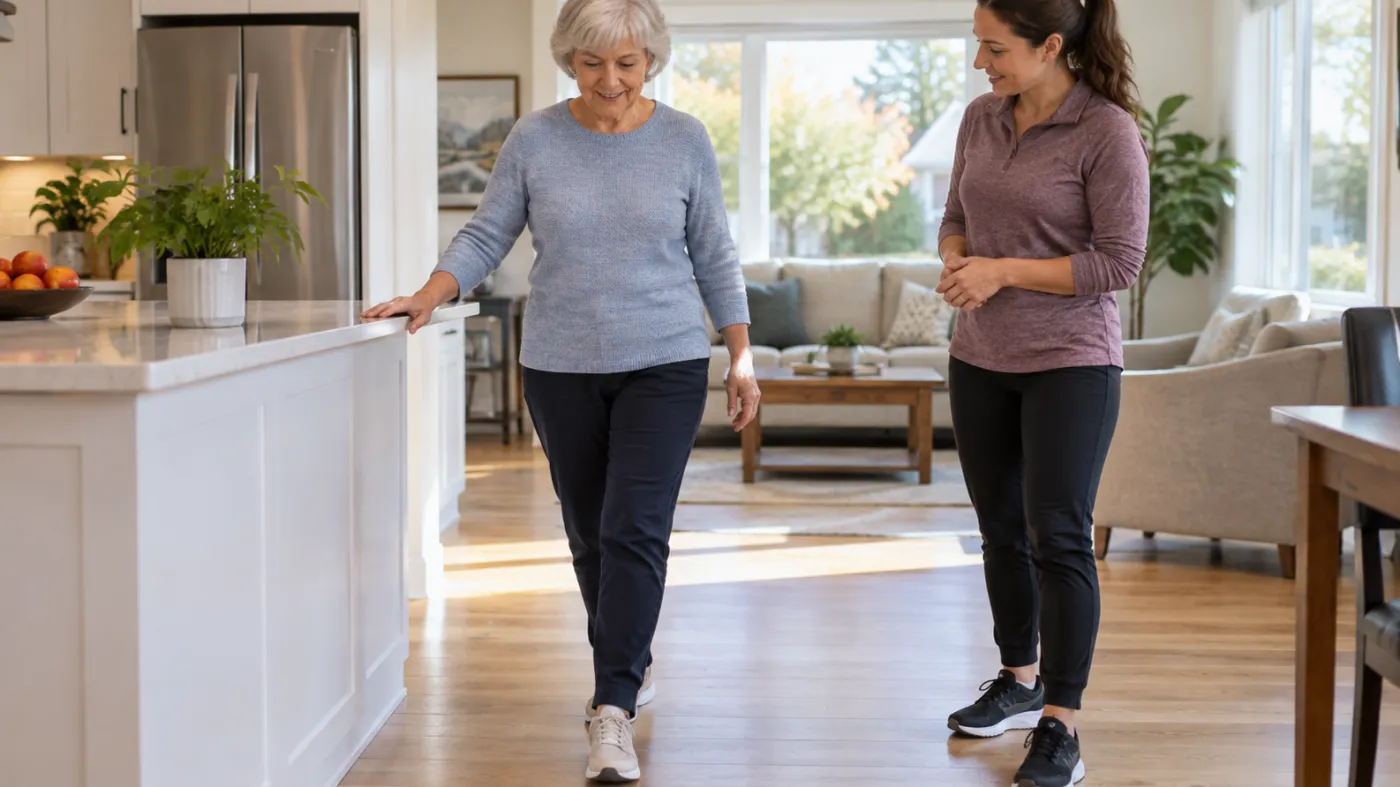
Balance training should challenge steadiness without turning every session into a test. A solid kitchen counter can provide a safer practice area than a lightweight chair, rolling table or towel rack. Keep the floor clear and have another person nearby when that is appropriate.
A starting sequence may include standing with the feet close together, placing one foot slightly ahead of the other and shifting weight from side to side. The goal is a calm posture with normal breathing, not rigid bracing. Light fingertip support is acceptable; over time, the hands may hover briefly if it is safe.
Controlled stepping is also valuable. Practise a small step forward and back, then sideways, while staying close to the counter. Focus on placing the whole foot and returning to the starting position. This introduces the kind of weight shift needed for curbs, crowded rooms and quick corrections.
Progress only one feature at a time. Narrowing the feet, reducing hand support, turning the head or standing on a softer surface all increase difficulty. Combining them too quickly can make an exercise unsafe and hides which change caused the loss of control.
Closing the eyes removes important visual information and should not be a casual home progression. It is often more appropriate under professional supervision, especially for anyone with sensory loss, dizziness or a history of falling.
Add movement before adding distraction
Real life sometimes requires walking while talking, carrying an item or looking for a street sign. These dual tasks divide attention and can expose balance difficulties. They can be trained, but only after the underlying movement is reasonably reliable.
Begin with physical changes such as direction turns, planned stops and different step lengths. Use a clear indoor route free from pets, cords and loose rugs. Once those tasks are steady, a simple conversation or light object may be introduced with supervision if needed.
Do not use mental distraction to make an unsafe activity harder. The purpose of practice is to increase adaptability, not to prove that a person can recover from repeated loss of balance.
Choose footwear for the task
Shoes affect the contact between the person and the ground. A secure heel, adequate width and a sole that grips the expected surface may improve confidence. Shoes that are too loose can slide on the foot, while long laces and worn soles can create hazards.
Indoors, consider whether socks on smooth flooring are less secure than well-fitting shoes or slippers with a stable sole. Outdoors, match footwear to weather and surface conditions. Winter traction aids may help on ice when used correctly, but they can become slippery on indoor tile and should be removed before walking inside.
Foot pain, calluses, reduced sensation and nail problems can alter gait. A foot-care professional may help when self-care is difficult or conditions such as diabetes require extra caution. Footwear should support the person; it should not be expected to correct every balance problem by itself.
Scan the home one room at a time
Familiar spaces can contain hazards that have become easy to overlook. Walk through the home slowly, ideally with another person, and examine the routes used at night, the entrance and the path to the bathroom.
Improve lighting at stairs, hallways and doorways. Keep switches accessible and consider night lights where someone may walk while drowsy. Remove clutter, cords and unstable furniture from common routes. Loose mats should be secured appropriately or removed, particularly where their edges curl.
Stairs need clear treads, dependable lighting and secure handrails. Items waiting to be carried upstairs should not occupy a step. If carrying laundry blocks the view, use smaller loads or another strategy that preserves a hand for the rail.
Bathrooms deserve special attention because water and transfers increase risk. Properly installed grab bars are different from towel bars, which are not designed to support body weight. Non-slip surfaces, an appropriate shower seat and a raised toilet seat may help some people, but equipment should match the person’s size and abilities.
In the kitchen, store frequently used items between knee and shoulder height when possible. Reaching overhead from a stool or climbing onto a chair creates unnecessary risk. A stable step stool with a handhold may be appropriate for some people, while others should ask for help or rearrange storage.
Plan for Markham weather and public spaces
Southern Ontario weather can change a familiar route quickly. Ice may be difficult to see, snow can hide uneven pavement and wet leaves reduce traction. Check conditions before leaving, allow extra time and choose a cleared entrance even when it is not the shortest path.
When outdoor conditions are poor, maintain activity indoors rather than abandoning it for the season. Community recreation programs, indoor walking routes and a simple home routine can preserve strength and confidence. The City of Markham’s parks, trails and recreation information can help residents identify suitable spaces, but current accessibility and surface conditions should still be confirmed.
When entering a building, pause to remove snow from footwear and let the eyes adjust to different lighting. Use railings where available. Carrying fewer items keeps a hand free and makes unexpected surface changes easier to manage.
Review medications, vision and blood pressure
Some medicines can contribute to sleepiness, dizziness or changes in blood pressure. The effect may become more noticeable when a new prescription is started, a dose changes or several medicines interact. Do not stop a prescribed medication independently. Instead, bring an up-to-date list, including non-prescription products, to a physician or pharmacist for review.
Report light-headedness after standing, especially if it leads to grabbing support or sitting down suddenly. Rising in stages may help some people: sit at the edge of the bed, move the ankles, stand with support and pause before walking. Persistent symptoms still require medical assessment.
Regular vision checks matter because depth perception, contrast and changing prescriptions affect navigation. Clean lenses and appropriate lighting can make edges easier to see. If bifocals or progressive lenses distort the view of stairs, an optometrist can discuss practical options.
Hearing changes can also affect awareness of the environment, while dehydration or inadequate food intake may contribute to weakness or light-headedness. These factors deserve attention as part of a complete plan.
Use mobility aids as tools, not symbols
A cane or walker can increase independence when it is the right device, adjusted correctly and used consistently. An aid that is too tall, too low or placed on the wrong side may be less helpful. Borrowing equipment without assessment can also introduce problems with brakes, grips or fit.
A physiotherapist, occupational therapist or other qualified professional can assess the environment and teach safe use. The aim is not simply to hand someone a device. It is to match the aid to walking ability, daily routes, transportation and home layout.
Using an appropriate aid early may support more activity. Avoiding it because of stigma can lead to less walking and further loss of capacity. Equipment should be framed around what it enables.
Respond thoughtfully after a fall
After a fall, pause before trying to stand. Check for severe pain, obvious injury, bleeding, weakness, numbness or confusion. If there may be a head, neck, hip or serious limb injury, or if the person cannot get up safely, call emergency services. Do not rush or pull on an injured person.
Emergency assessment is important for loss of consciousness, worsening headache, repeated vomiting, seizure, slurred speech, unusual behaviour or increasing drowsiness after a possible head impact. People taking blood thinners should receive prompt medical advice after a head injury even when symptoms seem mild.
If there is no apparent serious injury and the person has previously learned a safe floor-recovery method, they may move slowly toward a stable piece of furniture and rise in stages. Floor-recovery skills are best practised with a professional before they are needed.
Tell a healthcare professional about the fall. Record what happened beforehand, the direction of the fall, footwear, lighting and any dizziness. A fall without injury still provides information that can prevent the next one.
Rebuild confidence without avoiding everything
Fear after a fall is understandable. Avoiding every challenging activity can feel protective, but it may also reduce strength, balance and social connection. The solution is graded re-entry with the right supports.
Start with a predictable environment and a task that feels achievable. Repeat it until it becomes less demanding, then make a small progression. That may mean walking to the end of the hallway before returning to the lobby, or practising a curb with supervision before navigating a busy parking lot.
Confidence grows from successful experience, not reassurance alone. Celebrate useful measures such as consistent practice, smoother chair rises and a return to a valued outing. Speed is not the only sign of progress.
Know when an individualized assessment is appropriate
Seek professional assessment after a fall with injury, repeated falls, frequent near falls or a noticeable change in walking. New dizziness, fainting, sudden weakness, severe headache, chest pain, shortness of breath or new confusion needs prompt medical attention rather than a routine exercise appointment.
An individualized assessment may include walking speed, chair transfers, turning, foot sensation, strength and the ability to respond to a balance challenge. A home review can identify environmental barriers that a clinic test misses. The resulting plan should address the person’s actual activities and health conditions.
No article can determine which exercise or device is safe for every reader. The best program is specific enough to challenge the right systems and conservative enough to be practised consistently.
Build a weekly fall-prevention routine
A useful week combines several types of movement. Strength sessions develop force for stairs and transfers. Balance practice improves control in progressively harder positions. Walking or other aerobic activity maintains endurance for community life. Flexibility may help when restricted movement interferes with reaching or stepping, though stretching alone is not a complete fall-prevention program.
Keep sessions short enough to preserve quality. Five to ten minutes of focused balance work on several days may be more realistic than one long session. Connect practice to an established routine, such as after breakfast, while keeping safety equipment and stable support ready.
Review the plan when health, medication, vision or the home changes. Fall prevention is not a one-time checklist. It is an ongoing process of matching capacity and environment to the life a person wants to lead.
For residents seeking help with balance and fall prevention in Markham, a thoughtful starting point is a conversation about recent changes, meaningful goals and the places where confidence has narrowed. From there, practical training and environmental changes can work together to support safer, fuller participation.